How to Evaluate AI-Generated Answers
Build a repeatable evaluation set for accuracy, completeness and useful uncertainty.
A team is deciding whether an assistant can draft answers for its technical help center. Evaluation is valuable when it exposes specific weaknesses and supports decisions about permitted uses. Rather than starting with a long feature list, begin with the task itself. This makes it possible to compare alternatives against a real requirement and identify responsibilities before committing to a design.
Information submitted to a model is part of the application's data flow. It may pass through integrations, logs, retrieval indexes or review interfaces, each with its own access requirements. Identify the information the task actually needs and the people or systems that can see it. Data minimization and careful permissions should be designed into the workflow rather than applied after a system has accumulated records.
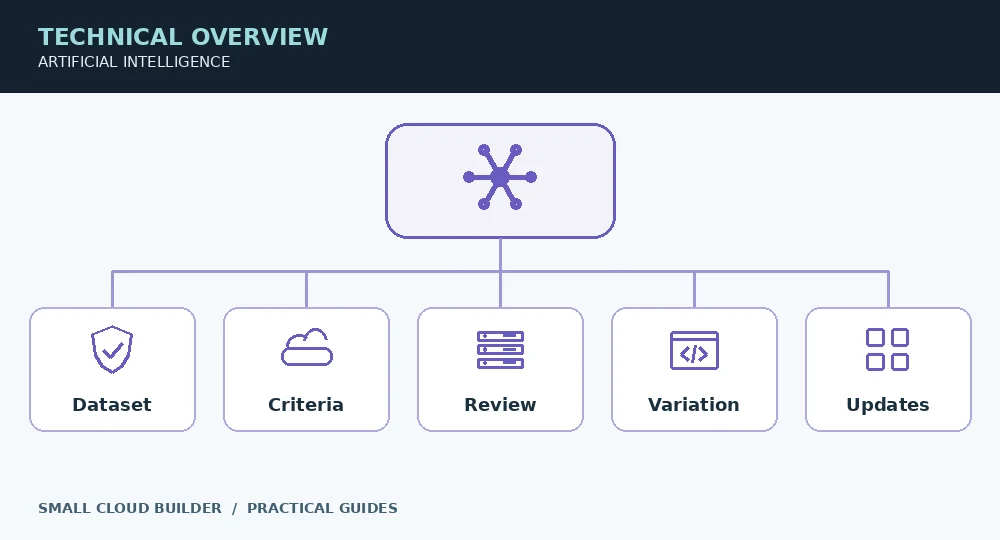
Dataset
Select a balanced sample of ordinary, rare, incomplete and unanswerable questions from approved sources.
An implementation plan should state who owns dataset once the work is complete. Include easily answered, difficult and unanswerable questions in the evaluation set. Ask the person responsible for ongoing administration to take part in verifying the result, rather than handing them an unfamiliar setup at the end. They need to know where to find the relevant configuration, what a normal result looks like and what to do if it changes unexpectedly. Where two roles share responsibility, document the handoff. In a small organization, clear ownership and a repeatable check often prevent problems that an additional piece of software would merely make more difficult to investigate.
Record a failure before changing several settings at once. A clear observation made under known conditions makes troubleshooting much easier. With multiple simultaneous changes, it may become difficult to tell which action corrected the issue or whether it merely hid the symptom.
Criteria
Define correct facts, mandatory steps, prohibited claims and acceptable uncertainty before grading responses.
There is a straightforward way to turn criteria into a decision instead of an argument about features. Write an expected response rubric before seeing generated answers. Keep the result in a short working note: the starting conditions, what was changed, what actually happened and the outcome that would be acceptable in production. If the result is different from the expected behavior, isolate the cause before adding another component. This is particularly important for a small team, where the person implementing a solution is often also the person who will have to maintain it and explain a failure to colleagues.
Treat a successful result as evidence for the particular situation that was tested. Changes to the environment can alter that behavior. A lightweight regression check after important changes makes it easier to identify when a previously dependable assumption no longer holds.
Review
Use a consistent rubric and qualified reviewers for consequential topics; compare disagreements.
An evaluation set of fifty questions might include ten that the knowledge base does not answer. If the assistant always provides a confident response, a fluency-only score could look excellent while those ten answers are unreliable. Include uncertainty handling and evidence quality in the scoring rubric.
Keep a distinction between normal operation and an unusual condition. Have two reviewers independently grade a sample and compare disagreement. Observe the ordinary result first, then use a controlled test environment to examine a reasonable edge case. The purpose is to understand the limitations, not to create a problem for live users. If the result cannot be reproduced, inspect the starting state and any dependencies before drawing a conclusion. The practical understanding of review should include both what happens when everything is working and how an operator can tell when the system has stopped meeting its intended requirement.
Avoid building the rest of the project around an undocumented assumption. The useful output here is a small record of the actual behavior and any constraints that may affect the next decision. If another person cannot interpret that record, add the missing context while it is still easy to recover.
For another perspective on the same infrastructure or workflow decision, see Prompt Design for Everyday Business Tasks. Compare the requirements it identifies with the constraints in your own environment.
Variation
Run representative requests more than once if outputs can vary, and capture model and instruction versions.
Start with what is already observable. Record model settings and selected document versions for every run. Write down the result alongside the original expectation. A useful comparison keeps the workload and the surrounding conditions stable; differences in sample size, connection quality or a change made elsewhere in the system can otherwise distort the conclusion. The value of this check is not that it proves the entire design. It exposes whether the assumption about variation holds under a recognizable working condition, and whether somebody has enough information to repeat the observation later without reconstructing the whole experiment from memory.
Before extending the setup, identify the part that is hardest to reverse. A limited pilot lets the team address problems in that part without affecting unrelated work. Keep the dependable existing process available until the replacement has passed the checks that matter.
Updates
Re-evaluate after changing models, retrieved content or system behavior, including previously failed cases.
Separate the initial selection from the evidence that supports it. Re-run known failure cases after changing retrieval or instructions. The test should be small enough that a mistake is reversible and sufficiently representative that the result can guide a decision. Record what direct observation establishes and what remains an assumption. For example, one successful run says little about unusual inputs or a much higher level of demand. Use the first observation to decide what another test ought to cover. As work moves from evaluation into routine operation, revisit the assumptions about updates rather than leaving them frozen in the original proposal.
There is no need for a large spreadsheet if a short set of observations is sufficient. The purpose is to make the decision traceable, distinguish known limitations from speculation and preserve enough information to investigate a reported problem later.
A model's fluent response does not establish the truth of its claims. Generated text depends on the supplied information, model behavior and the application's retrieval or instruction design. Separate the quality of the language from factual accuracy, and make a clear distinction between a proposed draft and an approved result. A test set with known answers helps expose errors that a convincing demonstration can hide.
Putting the findings to work
The useful cost measure for an AI workflow includes the effort needed to verify and correct results. Consider the average output, the uncommon difficult input and the consequences of an incorrect answer separately. An inexpensive automated draft that takes longer to repair than producing the original work does not provide a useful efficiency gain.
For a short review before making the decision, return to the concrete checks from the guide:
- Include easily answered, difficult and unanswerable questions in the evaluation set.
- Write an expected response rubric before seeing generated answers.
- Have two reviewers independently grade a sample and compare disagreement.
- Record model settings and selected document versions for every run.
- Re-run known failure cases after changing retrieval or instructions.
Evaluation is valuable when it exposes specific weaknesses and supports decisions about permitted uses. Keep the key observations available to the people responsible for the system, with enough detail to revisit the decision when the workload, tools or business requirements change.
Related guide: Practical AI for Small Business Operations. Find suitable low-risk uses for language models and automation.
Related guide: What Serverless Computing Actually Means. Evaluate event-driven functions, quotas and the operational consequences of managed execution.