Prompt Design for Everyday Business Tasks
Give an AI assistant clear context and reviewable output requirements.

An editorial team asks AI to help structure technical drafts but needs consistent terminology and accurate claims. Good instructions reduce avoidable ambiguity; they cannot make an unverified model output authoritative. This is a useful situation in which to make the technical requirements explicit before changing tools, because the choices affect day-to-day work as well as the initial setup.
The useful cost measure for an AI workflow includes the effort needed to verify and correct results. Consider the average output, the uncommon difficult input and the consequences of an incorrect answer separately. An inexpensive automated draft that takes longer to repair than producing the original work does not provide a useful efficiency gain.
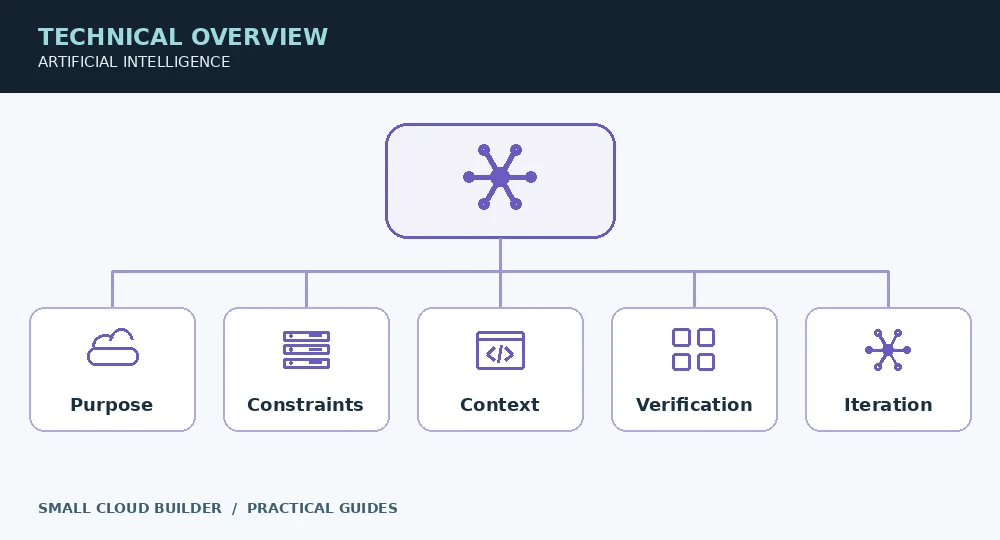
Purpose
Explain the task and audience, specify what information is provided and separate examples from requirements.
A demonstration can be misleading when it uses a perfectly prepared environment. The useful question is what happens during routine work. Provide terminology, audience and source facts for one realistic business task. Use an ordinary sample, with enough variation to reveal common problems but without requiring live customer records. Where behavior differs between a new environment and the existing one, establish which difference matters to the business before making a choice. Keep a record of errors and unexpected constraints as well as successes. An inconclusive test is a reason to refine the experiment, not a reason to assume that purpose has been solved.
Treat a successful result as evidence for the particular situation that was tested. Changes to the environment can alter that behavior. A lightweight regression check after important changes makes it easier to identify when a previously dependable assumption no longer holds.
Constraints
State relevant boundaries, prohibited assumptions and desired output structure without conflicting instructions.
A written requirement is most valuable when it can be tested without guessing what the author meant. Test what happens when an instruction is ambiguous or a requested fact is absent. Establish a meaningful threshold for the result, whether that is correctness, usable response time, preservation of records or successful access by the intended person. Do not silently revise the threshold after seeing a disappointing outcome; instead, decide whether the business requirement itself has changed. Even a modest record of test results helps a small team make later decisions about constraints without relying on a recollection of which option looked most convincing during the initial evaluation.
When comparing choices, include the ordinary maintenance procedure as a requirement. If the team can only demonstrate a capability with extensive assistance, plan for that dependency rather than assuming the same results will be available without it.
Context
Supply factual material and terminology; omit data the model does not need to see.
Start with what is already observable. Check names and numerical claims against the approved material. Write down the result alongside the original expectation. A useful comparison keeps the workload and the surrounding conditions stable; differences in sample size, connection quality or a change made elsewhere in the system can otherwise distort the conclusion. The value of this check is not that it proves the entire design. It exposes whether the assumption about context holds under a recognizable working condition, and whether somebody has enough information to repeat the observation later without reconstructing the whole experiment from memory.
If the exercise requires temporary privileges or a special configuration, separate those from what the finished system actually needs. Remove temporary access when it is no longer required and document the configuration that the team expects to keep.
For another perspective on the same infrastructure or workflow decision, see AI Governance for Small Organizations. Compare the requirements it identifies with the constraints in your own environment.
Verification
Ask for uncertainty when evidence is incomplete and check claims independently before using the output.
Compare a vague request to summarize a procedure with one specifying the audience, source document, required steps and how to handle missing facts. The second offers clearer evaluation criteria. If the model still invents an unsupported requirement, improve the workflow's review or retrieval rather than trusting a longer instruction.
For verification, a useful comparison is one that a colleague can independently reproduce. Compare two instruction versions using the same inputs. Describe the relevant starting conditions and save the result using consistent terminology. Avoid comparing a first-time setup in one system with an already optimized setup in another unless the difference is explicitly part of the evaluation. Make note of the effort required to reach a usable state as well as the eventual result. In a business environment, the time required to repeat a configuration, recover access or diagnose a problem is a real constraint, even when it is not reflected in a product specification.
It is worth writing down any restriction discovered during the check, including one that does not affect the present workload. A future maintainer may not have the same assumptions about data size, supported devices or how often the procedure needs to run.
Iteration
Change one instruction at a time, compare representative results and document versions that perform well.
In the planning stage, avoid treating iteration as a feature checkbox. Keep a record of prompts and expected behavior without including unnecessary private information. This gives the team a real starting point for comparison. Note how much setup and administrative effort the task requires, and whether the result can be repeated without relying on special access unavailable to ordinary users. If the proposed system changes the way a person completes their work, try the new process from that role's perspective as well. The aim is to establish what is possible with the configuration you will actually operate, rather than what is possible in an ideal demonstration.
Record a failure before changing several settings at once. A clear observation made under known conditions makes troubleshooting much easier. With multiple simultaneous changes, it may become difficult to tell which action corrected the issue or whether it merely hid the symptom.
Putting the findings to work
A model's fluent response does not establish the truth of its claims. Generated text depends on the supplied information, model behavior and the application's retrieval or instruction design. Separate the quality of the language from factual accuracy, and make a clear distinction between a proposed draft and an approved result. A test set with known answers helps expose errors that a convincing demonstration can hide.
For a short review before making the decision, return to the concrete checks from the guide:
- Provide terminology, audience and source facts for one realistic business task.
- Test what happens when an instruction is ambiguous or a requested fact is absent.
- Check names and numerical claims against the approved material.
- Compare two instruction versions using the same inputs.
- Keep a record of prompts and expected behavior without including unnecessary private information.
Good instructions reduce avoidable ambiguity; they cannot make an unverified model output authoritative. Keep the key observations available to the people responsible for the system, with enough detail to revisit the decision when the workload, tools or business requirements change.
Related guide: Generative AI vs Traditional Automation. Know when a model is helpful and when deterministic rules are more reliable.
Related guide: How Workflow Automation Tools Connect SaaS Applications. Design dependable integration flows with clear events, data mappings and error handling.