Local AI Models vs Hosted AI Services
Compare infrastructure ownership, model quality, privacy and operational effort.

A research team wants to process internal documents and is comparing an on-premises model with a hosted API. Choose the deployment model that meets actual quality and governance needs within available resources. The following guide treats the problem as a working decision: what needs to happen, what the technology actually provides, and which observations can support a choice.
A model's fluent response does not establish the truth of its claims. Generated text depends on the supplied information, model behavior and the application's retrieval or instruction design. Separate the quality of the language from factual accuracy, and make a clear distinction between a proposed draft and an approved result. A test set with known answers helps expose errors that a convincing demonstration can hide.
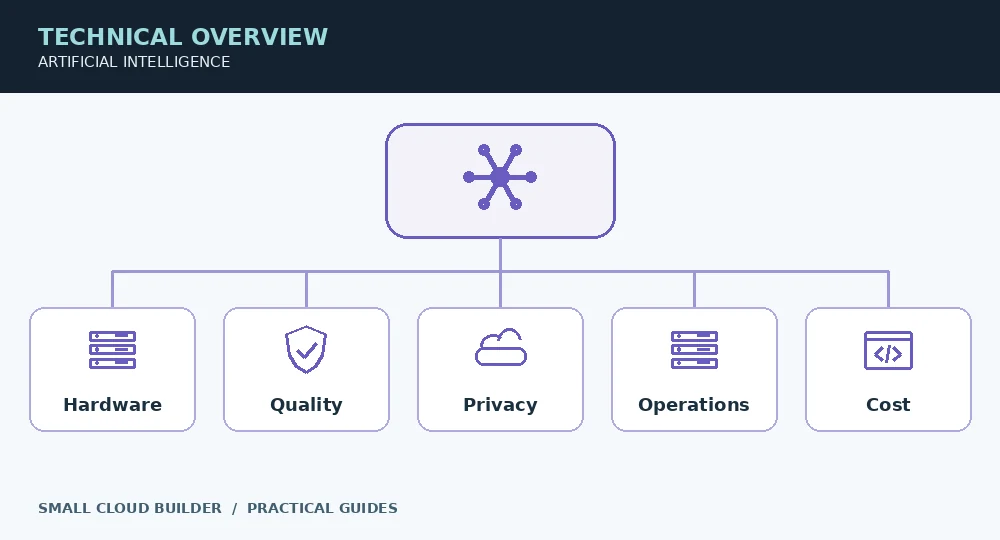
Hardware
Measure usable memory, inference speed, concurrency and energy demand for a candidate local model.
Separate the initial selection from the evidence that supports it. Test a representative document on both a local model and an approved hosted service. The test should be small enough that a mistake is reversible and sufficiently representative that the result can guide a decision. Record what direct observation establishes and what remains an assumption. For example, one successful run says little about unusual inputs or a much higher level of demand. Use the first observation to decide what another test ought to cover. As work moves from evaluation into routine operation, revisit the assumptions about hardware rather than leaving them frozen in the original proposal.
There is no need for a large spreadsheet if a short set of observations is sufficient. The purpose is to make the decision traceable, distinguish known limitations from speculation and preserve enough information to investigate a reported problem later.
Quality
Evaluate real tasks, including undesirable answers and long documents, instead of comparing parameter count only.
A local machine may deliver acceptable results for one document at a time but struggle when several colleagues request summaries concurrently. Benchmark both single-request latency and queue behavior. Hosted usage similarly needs realistic concurrency and quota planning rather than measuring one convenient demonstration.
Start with what is already observable. Measure processing time and memory at expected concurrency. Write down the result alongside the original expectation. A useful comparison keeps the workload and the surrounding conditions stable; differences in sample size, connection quality or a change made elsewhere in the system can otherwise distort the conclusion. The value of this check is not that it proves the entire design. It exposes whether the assumption about quality holds under a recognizable working condition, and whether somebody has enough information to repeat the observation later without reconstructing the whole experiment from memory.
The people who carry out routine work may notice different problems from the person who set up the system. Include their observations, particularly repeated manual steps or confusing states. These details can dominate the long-term effort even when the underlying technology performs well.
Privacy
Map data routing, logs, backups and administrators for both local and hosted deployments.
A written requirement is most valuable when it can be tested without guessing what the author meant. Map whether any document text appears in logs or backups. Establish a meaningful threshold for the result, whether that is correctness, usable response time, preservation of records or successful access by the intended person. Do not silently revise the threshold after seeing a disappointing outcome; instead, decide whether the business requirement itself has changed. Even a modest record of test results helps a small team make later decisions about privacy without relying on a recollection of which option looked most convincing during the initial evaluation.
Before extending the setup, identify the part that is hardest to reverse. A limited pilot lets the team address problems in that part without affecting unrelated work. Keep the dependable existing process available until the replacement has passed the checks that matter.
For another perspective on the same infrastructure or workflow decision, see How to Evaluate AI-Generated Answers. Compare the requirements it identifies with the constraints in your own environment.
Operations
Local systems require upgrades, monitoring and spare capacity; hosted services add dependence on external availability and terms.
In the planning stage, avoid treating operations as a feature checkbox. Estimate electricity, replacement hardware and administrator hours. This gives the team a real starting point for comparison. Note how much setup and administrative effort the task requires, and whether the result can be repeated without relying on special access unavailable to ordinary users. If the proposed system changes the way a person completes their work, try the new process from that role's perspective as well. The aim is to establish what is possible with the configuration you will actually operate, rather than what is possible in an ideal demonstration.
If the exercise requires temporary privileges or a special configuration, separate those from what the finished system actually needs. Remove temporary access when it is no longer required and document the configuration that the team expects to keep.
Cost
Include idle hardware and staff time as well as per-use API charges, and test expected demand.
A less obvious part of cost is the boundary between an individual task and the system around it. Compare factual answer quality rather than selecting a model based only on size. Check the environment before and after the exercise, making sure unrelated records or settings have not changed. Record any dependencies required for success and distinguish permanent requirements from one-time setup work. A process that depends on a temporary test account, a particular device or an undocumented configuration may need additional work before it is ready for normal use. Leave room in the plan for that discovery rather than committing to a launch date on the strength of a first successful attempt.
Avoid building the rest of the project around an undocumented assumption. The useful output here is a small record of the actual behavior and any constraints that may affect the next decision. If another person cannot interpret that record, add the missing context while it is still easy to recover.
Putting the findings to work
Information submitted to a model is part of the application's data flow. It may pass through integrations, logs, retrieval indexes or review interfaces, each with its own access requirements. Identify the information the task actually needs and the people or systems that can see it. Data minimization and careful permissions should be designed into the workflow rather than applied after a system has accumulated records.
For a short review before making the decision, return to the concrete checks from the guide:
- Test a representative document on both a local model and an approved hosted service.
- Measure processing time and memory at expected concurrency.
- Map whether any document text appears in logs or backups.
- Estimate electricity, replacement hardware and administrator hours.
- Compare factual answer quality rather than selecting a model based only on size.
Choose the deployment model that meets actual quality and governance needs within available resources. Keep the key observations available to the people responsible for the system, with enough detail to revisit the decision when the workload, tools or business requirements change.
Related guide: AI Governance for Small Organizations. Create proportionate policies for data use, review and accountability.
Related guide: Static Sites vs Dynamic Websites. Compare rendering models, content management and operational requirements.