Static Sites vs Dynamic Websites
Compare rendering models, content management and operational requirements.
A publisher needs a knowledge base while its separate customer portal needs authenticated pages. Choose rendering according to page behavior; a single website can use multiple approaches. This is a useful situation in which to make the technical requirements explicit before changing tools, because the choices affect day-to-day work as well as the initial setup.
The browser receives a document, associated resources and, depending on the application, executable client-side code. Server behavior and client behavior should be checked independently. A site can return valid HTML but be hard to navigate, or have an attractive interface that fails when the network is interrupted. Testing the actual interactions people need is more revealing than treating a visual match as sufficient.
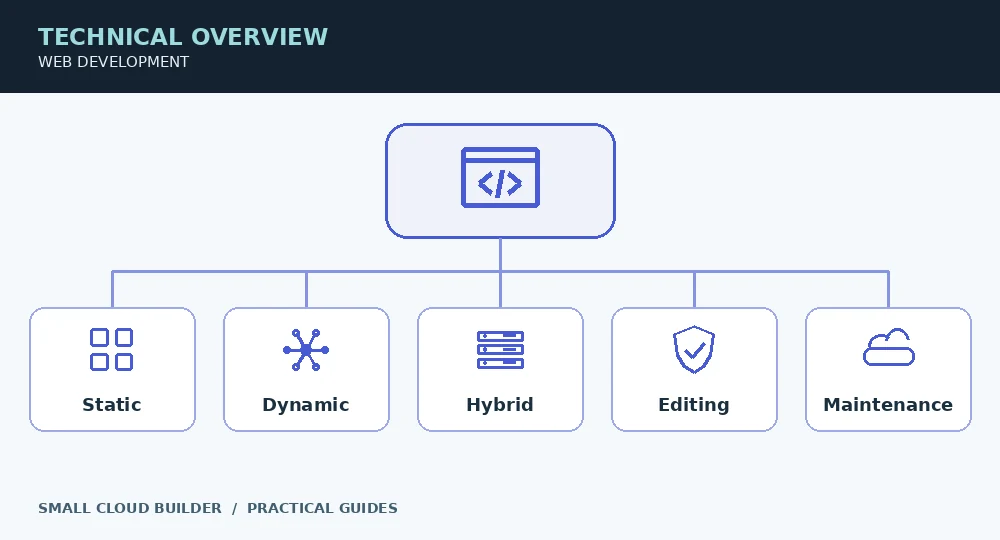
Static
Prebuilt documents can be served directly and cached widely; new content requires generation and deployment.
Start with what is already observable. Compare a public guide served directly from files with a personalized account page. Write down the result alongside the original expectation. A useful comparison keeps the workload and the surrounding conditions stable; differences in sample size, connection quality or a change made elsewhere in the system can otherwise distort the conclusion. The value of this check is not that it proves the entire design. It exposes whether the assumption about static holds under a recognizable working condition, and whether somebody has enough information to repeat the observation later without reconstructing the whole experiment from memory.
There is no need for a large spreadsheet if a short set of observations is sufficient. The purpose is to make the decision traceable, distinguish known limitations from speculation and preserve enough information to investigate a reported problem later.
Dynamic
Server-rendered pages respond to request state and database changes, introducing runtime dependencies.
A product guide is the same for everyone and can be generated at publication time. An account page depends on the signed-in user and current billing records. Serving both from the same unrestricted cache would be inappropriate; each route needs behavior consistent with its state and permissions.
Keep a distinction between normal operation and an unusual condition. Check how a corrected article is regenerated and published. Observe the ordinary result first, then use a controlled test environment to examine a reasonable edge case. The purpose is to understand the limitations, not to create a problem for live users. If the result cannot be reproduced, inspect the starting state and any dependencies before drawing a conclusion. The practical understanding of dynamic should include both what happens when everything is working and how an operator can tell when the system has stopped meeting its intended requirement.
The cost of an incorrect assumption increases as more people or records depend on it. Resolve uncertainty while the configuration is still small. A precise limitation is more useful than a general assurance that the system should probably work in a larger environment.
Hybrid
Use static pages for public material and dynamic endpoints for personalized operations; maintain clear caching rules.
An implementation plan should state who owns hybrid once the work is complete. Measure an uncached request for the dynamic route under ordinary demand. Ask the person responsible for ongoing administration to take part in verifying the result, rather than handing them an unfamiliar setup at the end. They need to know where to find the relevant configuration, what a normal result looks like and what to do if it changes unexpectedly. Where two roles share responsibility, document the handoff. In a small organization, clear ownership and a repeatable check often prevent problems that an additional piece of software would merely make more difficult to investigate.
Before extending the setup, identify the part that is hardest to reverse. A limited pilot lets the team address problems in that part without affecting unrelated work. Keep the dependable existing process available until the replacement has passed the checks that matter.
For another perspective on the same infrastructure or workflow decision, see HTML Semantic Structure for Better Websites. Compare the requirements it identifies with the constraints in your own environment.
Editing
Evaluate the publishing workflow, previews and permissions before selecting a generator or CMS.
Separate the initial selection from the evidence that supports it. Verify private responses cannot be exposed through the static cache. The test should be small enough that a mistake is reversible and sufficiently representative that the result can guide a decision. Record what direct observation establishes and what remains an assumption. For example, one successful run says little about unusual inputs or a much higher level of demand. Use the first observation to decide what another test ought to cover. As work moves from evaluation into routine operation, revisit the assumptions about editing rather than leaving them frozen in the original proposal.
The people who carry out routine work may notice different problems from the person who set up the system. Include their observations, particularly repeated manual steps or confusing states. These details can dominate the long-term effort even when the underlying technology performs well.
Maintenance
Compare update risk, error handling, deployment rollback and recovery effort across models.
A less obvious part of maintenance is the boundary between an individual task and the system around it. Ask an editor to preview and publish a harmless change without developer intervention. Check the environment before and after the exercise, making sure unrelated records or settings have not changed. Record any dependencies required for success and distinguish permanent requirements from one-time setup work. A process that depends on a temporary test account, a particular device or an undocumented configuration may need additional work before it is ready for normal use. Leave room in the plan for that discovery rather than committing to a launch date on the strength of a first successful attempt.
When comparing choices, include the ordinary maintenance procedure as a requirement. If the team can only demonstrate a capability with extensive assistance, plan for that dependency rather than assuming the same results will be available without it.
Putting the findings to work
A useful development release has a reproducible build and an environment in which changes can be checked before normal users receive them. Keep versioned source material and expected test cases, but avoid putting private configuration or data exports in public artifacts. When behavior changes, compare the deployed version with the source version and the relevant environment settings.
For a short review before making the decision, return to the concrete checks from the guide:
- Compare a public guide served directly from files with a personalized account page.
- Check how a corrected article is regenerated and published.
- Measure an uncached request for the dynamic route under ordinary demand.
- Verify private responses cannot be exposed through the static cache.
- Ask an editor to preview and publish a harmless change without developer intervention.
Choose rendering according to page behavior; a single website can use multiple approaches. Keep the key observations available to the people responsible for the system, with enough detail to revisit the decision when the workload, tools or business requirements change.
Related guide: Web Performance Basics for Developers. Reduce unnecessary requests, transfer size and main-thread work.
Related guide: Local AI Models vs Hosted AI Services. Compare infrastructure ownership, model quality, privacy and operational effort.