Generative AI vs Traditional Automation
Know when a model is helpful and when deterministic rules are more reliable.

An operations team processes standard forms, unstructured messages and monthly reports. Choose the simplest method that satisfies the accuracy and control requirements of each task. The details matter more than product labels. The challenge is to understand which parts of the system the business depends on, where the limits are and how to check the proposed approach under realistic conditions.
Information submitted to a model is part of the application's data flow. It may pass through integrations, logs, retrieval indexes or review interfaces, each with its own access requirements. Identify the information the task actually needs and the people or systems that can see it. Data minimization and careful permissions should be designed into the workflow rather than applied after a system has accumulated records.
Rules
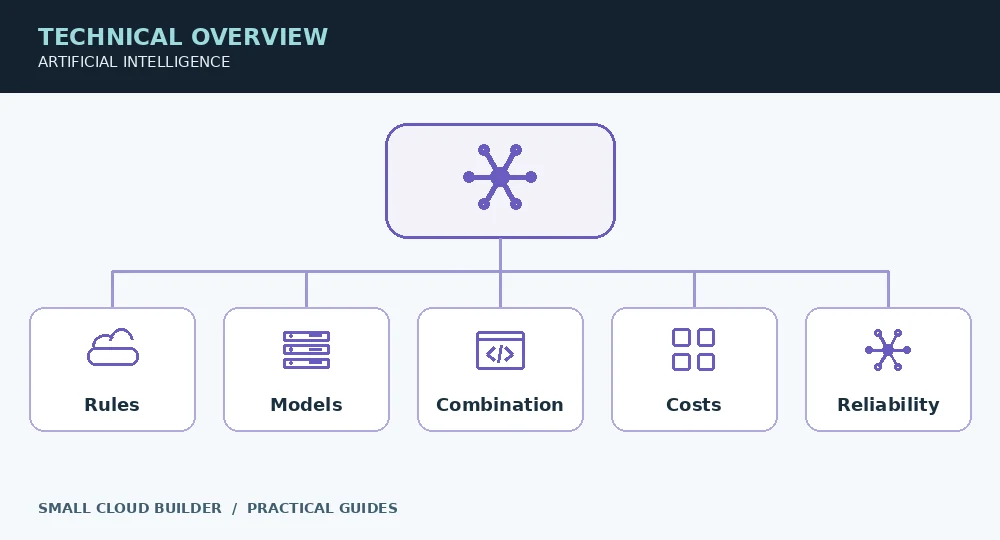
Use deterministic validation and calculations for structured inputs and decisions with exact requirements.
An implementation plan should state who owns rules once the work is complete. Compare a calculation handled by fixed logic with an unstructured summary handled by a model. Ask the person responsible for ongoing administration to take part in verifying the result, rather than handing them an unfamiliar setup at the end. They need to know where to find the relevant configuration, what a normal result looks like and what to do if it changes unexpectedly. Where two roles share responsibility, document the handoff. In a small organization, clear ownership and a repeatable check often prevent problems that an additional piece of software would merely make more difficult to investigate.
It is worth writing down any restriction discovered during the check, including one that does not affect the present workload. A future maintainer may not have the same assumptions about data size, supported devices or how often the procedure needs to run.
Models
Language models can summarize, categorize or draft from variable inputs but can produce plausible errors.
A written requirement is most valuable when it can be tested without guessing what the author meant. Test a missing field using deterministic validation first. Establish a meaningful threshold for the result, whether that is correctness, usable response time, preservation of records or successful access by the intended person. Do not silently revise the threshold after seeing a disappointing outcome; instead, decide whether the business requirement itself has changed. Even a modest record of test results helps a small team make later decisions about models without relying on a recollection of which option looked most convincing during the initial evaluation.
There is no need for a large spreadsheet if a short set of observations is sufficient. The purpose is to make the decision traceable, distinguish known limitations from speculation and preserve enough information to investigate a reported problem later.
Combination
Apply validation and extraction where suitable, then route uncertain outputs to a responsible reviewer.
A tax calculation based on explicitly defined inputs should be produced by a suitable deterministic calculation and checked against known examples. A language model may help explain a result or classify an accompanying message, but it should not replace the underlying calculation. The two components have different reliability requirements.
Start with what is already observable. Check what happens when a message contains conflicting information. Write down the result alongside the original expectation. A useful comparison keeps the workload and the surrounding conditions stable; differences in sample size, connection quality or a change made elsewhere in the system can otherwise distort the conclusion. The value of this check is not that it proves the entire design. It exposes whether the assumption about combination holds under a recognizable working condition, and whether somebody has enough information to repeat the observation later without reconstructing the whole experiment from memory.
Treat a successful result as evidence for the particular situation that was tested. Changes to the environment can alter that behavior. A lightweight regression check after important changes makes it easier to identify when a previously dependable assumption no longer holds.
For another perspective on the same infrastructure or workflow decision, see How Large Language Models Process Text. Compare the requirements it identifies with the constraints in your own environment.
Costs
Measure calls, latency and review effort as well as engineering and subscription costs.
For costs, a useful comparison is one that a colleague can independently reproduce. Estimate the effort of correcting ten inaccurate generated outputs. Describe the relevant starting conditions and save the result using consistent terminology. Avoid comparing a first-time setup in one system with an already optimized setup in another unless the difference is explicitly part of the evaluation. Make note of the effort required to reach a usable state as well as the eventual result. In a business environment, the time required to repeat a configuration, recover access or diagnose a problem is a real constraint, even when it is not reflected in a product specification.
Before extending the setup, identify the part that is hardest to reverse. A limited pilot lets the team address problems in that part without affecting unrelated work. Keep the dependable existing process available until the replacement has passed the checks that matter.
Reliability
Use representative test cases including incomplete, conflicting and unusual inputs.
A demonstration can be misleading when it uses a perfectly prepared environment. The useful question is what happens during routine work. Record which decisions must never depend on an unreviewed model answer. Use an ordinary sample, with enough variation to reveal common problems but without requiring live customer records. Where behavior differs between a new environment and the existing one, establish which difference matters to the business before making a choice. Keep a record of errors and unexpected constraints as well as successes. An inconclusive test is a reason to refine the experiment, not a reason to assume that reliability has been solved.
When comparing choices, include the ordinary maintenance procedure as a requirement. If the team can only demonstrate a capability with extensive assistance, plan for that dependency rather than assuming the same results will be available without it.
Putting the findings to work
The useful cost measure for an AI workflow includes the effort needed to verify and correct results. Consider the average output, the uncommon difficult input and the consequences of an incorrect answer separately. An inexpensive automated draft that takes longer to repair than producing the original work does not provide a useful efficiency gain.
For a short review before making the decision, return to the concrete checks from the guide:
- Compare a calculation handled by fixed logic with an unstructured summary handled by a model.
- Test a missing field using deterministic validation first.
- Check what happens when a message contains conflicting information.
- Estimate the effort of correcting ten inaccurate generated outputs.
- Record which decisions must never depend on an unreviewed model answer.
Choose the simplest method that satisfies the accuracy and control requirements of each task. Keep the key observations available to the people responsible for the system, with enough detail to revisit the decision when the workload, tools or business requirements change.
Related guide: AI Chatbots for Business Websites. Design a support assistant with a narrow purpose, reliable fallback and measurable results.
Related guide: Public Cloud vs Private Cloud vs Hybrid Cloud. Understand which deployment model suits workloads, compliance and operational resources.