How Cloud Billing Works: Estimate and Control Costs
Read usage-based invoices and establish a practical monthly forecast.
A reporting application runs continuously but receives bursts of traffic around the end of each month. A spend alert is a signal to investigate, not a guarantee that consumption has stopped. Rather than starting with a long feature list, begin with the task itself. This makes it possible to compare alternatives against a real requirement and identify responsibilities before committing to a design.
Cloud infrastructure splits responsibility across multiple control layers. Physical facilities, network services, guest systems, managed runtimes, application configuration and data can all have different operators. A hosting invoice may list a resource that looks self-contained even though it depends on identity services, DNS, monitoring and recovery storage. Draw the few boundaries that matter for this workload first. In the event of a problem, they are often more useful than a diagram showing every available cloud service.
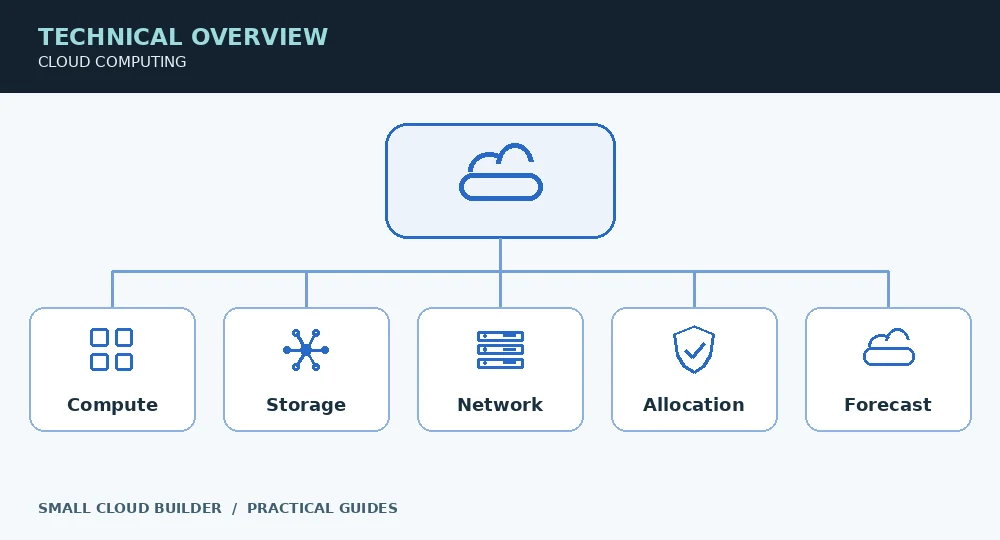
Compute
Estimate instance hours and size separately. A machine left on all month uses roughly 730 hours in a typical month.
A written requirement is most valuable when it can be tested without guessing what the author meant. Compare 730 instance hours with an application that only needs 120 hours of compute. Establish a meaningful threshold for the result, whether that is correctness, usable response time, preservation of records or successful access by the intended person. Do not silently revise the threshold after seeing a disappointing outcome; instead, decide whether the business requirement itself has changed. Even a modest record of test results helps a small team make later decisions about compute without relying on a recollection of which option looked most convincing during the initial evaluation.
There is no need for a large spreadsheet if a short set of observations is sufficient. The purpose is to make the decision traceable, distinguish known limitations from speculation and preserve enough information to investigate a reported problem later.
Storage
Distinguish allocated and consumed capacity, requests, snapshots and retention. Old snapshots may remain after an instance is removed.
Suppose a test workload consumes 40 GB of stored data and sends 20 GB of responses each month. At purely illustrative rates of $0.025 per GB-month and $0.10 per outbound GB, the storage and egress components would be $1 and $2, respectively. Compute, request fees, snapshots and taxes are separate; these numbers are not a vendor quote.
Separate the initial selection from the evidence that supports it. Find snapshots and unattached volumes that no longer have a documented owner. The test should be small enough that a mistake is reversible and sufficiently representative that the result can guide a decision. Record what direct observation establishes and what remains an assumption. For example, one successful run says little about unusual inputs or a much higher level of demand. Use the first observation to decide what another test ought to cover. As work moves from evaluation into routine operation, revisit the assumptions about storage rather than leaving them frozen in the original proposal.
It is worth writing down any restriction discovered during the check, including one that does not affect the present workload. A future maintainer may not have the same assumptions about data size, supported devices or how often the procedure needs to run.
Network
Include egress, inter-zone transfers and load balancer processing. Inbound transfer may be priced differently.
A less obvious part of network is the boundary between an individual task and the system around it. Calculate outbound transfer for a month of representative downloadable content. Check the environment before and after the exercise, making sure unrelated records or settings have not changed. Record any dependencies required for success and distinguish permanent requirements from one-time setup work. A process that depends on a temporary test account, a particular device or an undocumented configuration may need additional work before it is ready for normal use. Leave room in the plan for that discovery rather than committing to a launch date on the strength of a first successful attempt.
When comparing choices, include the ordinary maintenance procedure as a requirement. If the team can only demonstrate a capability with extensive assistance, plan for that dependency rather than assuming the same results will be available without it.
For another perspective on the same infrastructure or workflow decision, see Cloud Regions and Availability Zones Explained. Compare the requirements it identifies with the constraints in your own environment.
Allocation
Tag resources with project and owner. Separate production, test and shared costs before setting budgets.
The distinction becomes easier to see with an explicit acceptance test. Reconcile a project-level bill against tags and individual resource usage. Decide in advance which outcome would be a success. A measurement that looks impressive on its own may be irrelevant if the original task remains difficult or unreliable. Track failures alongside the successful result; a capability that works only when a particular person is present may be less useful than a slightly slower process anyone on the team can follow. The final choice should reflect the actual working requirements around allocation, including what the team can reasonably support after the initial installation.
If the exercise requires temporary privileges or a special configuration, separate those from what the finished system actually needs. Remove temporary access when it is no longer required and document the configuration that the team expects to keep.
Forecast
Compare actual demand against a low, expected and peak scenario, not a promotional starting price.
Separate the initial selection from the evidence that supports it. Check whether crossing the alert threshold changes behavior or merely sends a notification. The test should be small enough that a mistake is reversible and sufficiently representative that the result can guide a decision. Record what direct observation establishes and what remains an assumption. For example, one successful run says little about unusual inputs or a much higher level of demand. Use the first observation to decide what another test ought to cover. As work moves from evaluation into routine operation, revisit the assumptions about forecast rather than leaving them frozen in the original proposal.
The cost of an incorrect assumption increases as more people or records depend on it. Resolve uncertainty while the configuration is still small. A precise limitation is more useful than a general assurance that the system should probably work in a larger environment.
Putting the findings to work
Capacity and availability are related but not identical. A system can have abundant capacity and still be unavailable if an essential dependency fails. A redundant design can also perform badly if surviving components cannot handle the traffic. Treat an observed performance limit and a failure-recovery target as separate requirements and test them with appropriate workloads.
For a short review before making the decision, return to the concrete checks from the guide:
- Compare 730 instance hours with an application that only needs 120 hours of compute.
- Find snapshots and unattached volumes that no longer have a documented owner.
- Calculate outbound transfer for a month of representative downloadable content.
- Reconcile a project-level bill against tags and individual resource usage.
- Check whether crossing the alert threshold changes behavior or merely sends a notification.
A spend alert is a signal to investigate, not a guarantee that consumption has stopped. Keep the key observations available to the people responsible for the system, with enough detail to revisit the decision when the workload, tools or business requirements change.
Related guide: What Serverless Computing Actually Means. Evaluate event-driven functions, quotas and the operational consequences of managed execution.
Related guide: AI API Costs: Estimating Tokens and Usage. Forecast text model expenses without relying on a single per-request price.