AI API Costs: Estimating Tokens and Usage
Forecast text model expenses without relying on a single per-request price.
A support application expects short interactive conversations with occasional long knowledge excerpts. A trustworthy forecast includes actual token measurements from a trial rather than guessing from message count alone. The details matter more than product labels. The challenge is to understand which parts of the system the business depends on, where the limits are and how to check the proposed approach under realistic conditions.
The useful cost measure for an AI workflow includes the effort needed to verify and correct results. Consider the average output, the uncommon difficult input and the consequences of an incorrect answer separately. An inexpensive automated draft that takes longer to repair than producing the original work does not provide a useful efficiency gain.
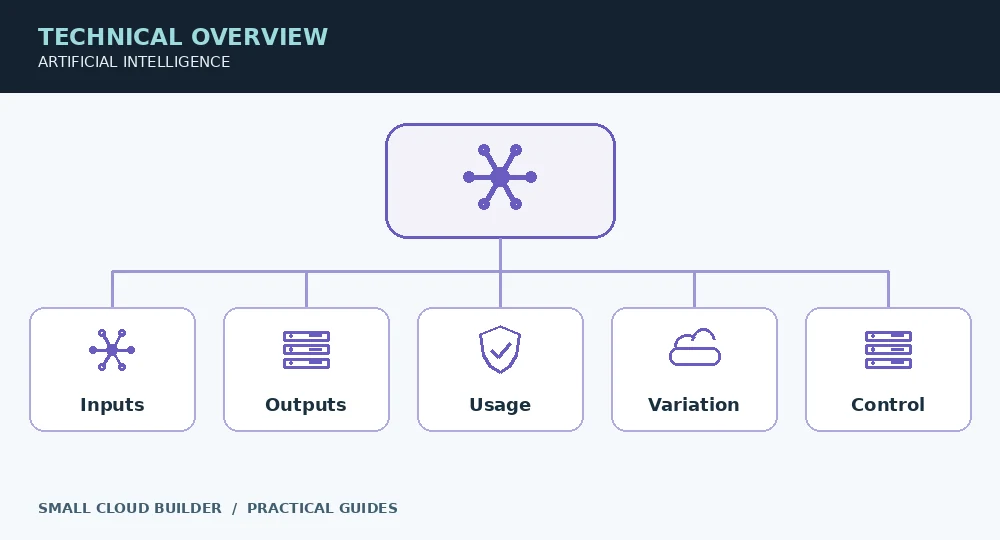
Inputs
Estimate repeated instructions, user content, conversation history and retrieved passages for typical requests.
Keep a distinction between normal operation and an unusual condition. Measure input tokens for a representative message with and without conversation history. Observe the ordinary result first, then use a controlled test environment to examine a reasonable edge case. The purpose is to understand the limitations, not to create a problem for live users. If the result cannot be reproduced, inspect the starting state and any dependencies before drawing a conclusion. The practical understanding of inputs should include both what happens when everything is working and how an operator can tell when the system has stopped meeting its intended requirement.
The cost of an incorrect assumption increases as more people or records depend on it. Resolve uncertainty while the configuration is still small. A precise limitation is more useful than a general assurance that the system should probably work in a larger environment.
Outputs
Estimate response length separately; model pricing may distinguish input and output tokens.
In the planning stage, avoid treating outputs as a feature checkbox. Compare twelve short replies with two deliberately long requests. This gives the team a real starting point for comparison. Note how much setup and administrative effort the task requires, and whether the result can be repeated without relying on special access unavailable to ordinary users. If the proposed system changes the way a person completes their work, try the new process from that role's perspective as well. The aim is to establish what is possible with the configuration you will actually operate, rather than what is possible in an ideal demonstration.
Treat a successful result as evidence for the particular situation that was tested. Changes to the environment can alter that behavior. A lightweight regression check after important changes makes it easier to identify when a previously dependable assumption no longer holds.
Usage
Multiply expected per-request consumption by volume, including retries and background tasks.
An implementation plan should state who owns usage once the work is complete. Include the tokens of retrieved excerpts and repeated instructions in estimates. Ask the person responsible for ongoing administration to take part in verifying the result, rather than handing them an unfamiliar setup at the end. They need to know where to find the relevant configuration, what a normal result looks like and what to do if it changes unexpectedly. Where two roles share responsibility, document the handoff. In a small organization, clear ownership and a repeatable check often prevent problems that an additional piece of software would merely make more difficult to investigate.
There is no need for a large spreadsheet if a short set of observations is sufficient. The purpose is to make the decision traceable, distinguish known limitations from speculation and preserve enough information to investigate a reported problem later.
For another perspective on the same infrastructure or workflow decision, see Local AI Models vs Hosted AI Services. Compare the requirements it identifies with the constraints in your own environment.
Variation
Calculate costs for ordinary and heavy usage scenarios, plus possible fees for storage or tools.
At an illustrative rate of $0.40 per million input tokens, 10,000 requests using 2,000 input tokens each would cost $8 for that input alone. If each also generates 400 output tokens, the output represents another four million tokens priced at the applicable output rate. This excludes other tools, retries and infrastructure.
A less obvious part of variation is the boundary between an individual task and the system around it. Multiply peak and typical volumes by the appropriate input and output rates. Check the environment before and after the exercise, making sure unrelated records or settings have not changed. Record any dependencies required for success and distinguish permanent requirements from one-time setup work. A process that depends on a temporary test account, a particular device or an undocumented configuration may need additional work before it is ready for normal use. Leave room in the plan for that discovery rather than committing to a launch date on the strength of a first successful attempt.
If the exercise requires temporary privileges or a special configuration, separate those from what the finished system actually needs. Remove temporary access when it is no longer required and document the configuration that the team expects to keep.
Control
Set response limits, appropriate model selection, monitoring and clear application-side quotas.
Separate the initial selection from the evidence that supports it. Check observed trial spending against the forecast and adjust quotas. The test should be small enough that a mistake is reversible and sufficiently representative that the result can guide a decision. Record what direct observation establishes and what remains an assumption. For example, one successful run says little about unusual inputs or a much higher level of demand. Use the first observation to decide what another test ought to cover. As work moves from evaluation into routine operation, revisit the assumptions about control rather than leaving them frozen in the original proposal.
Before extending the setup, identify the part that is hardest to reverse. A limited pilot lets the team address problems in that part without affecting unrelated work. Keep the dependable existing process available until the replacement has passed the checks that matter.
Putting the findings to work
A model's fluent response does not establish the truth of its claims. Generated text depends on the supplied information, model behavior and the application's retrieval or instruction design. Separate the quality of the language from factual accuracy, and make a clear distinction between a proposed draft and an approved result. A test set with known answers helps expose errors that a convincing demonstration can hide.
For a short review before making the decision, return to the concrete checks from the guide:
- Measure input tokens for a representative message with and without conversation history.
- Compare twelve short replies with two deliberately long requests.
- Include the tokens of retrieved excerpts and repeated instructions in estimates.
- Multiply peak and typical volumes by the appropriate input and output rates.
- Check observed trial spending against the forecast and adjust quotas.
A trustworthy forecast includes actual token measurements from a trial rather than guessing from message count alone. Keep the key observations available to the people responsible for the system, with enough detail to revisit the decision when the workload, tools or business requirements change.
Related guide: Prompt Design for Everyday Business Tasks. Give an AI assistant clear context and reviewable output requirements.
Related guide: How Cloud Billing Works: Estimate and Control Costs. Read usage-based invoices and establish a practical monthly forecast.