Cloud Regions and Availability Zones Explained
Plan placement around latency, service availability and regional failure boundaries.
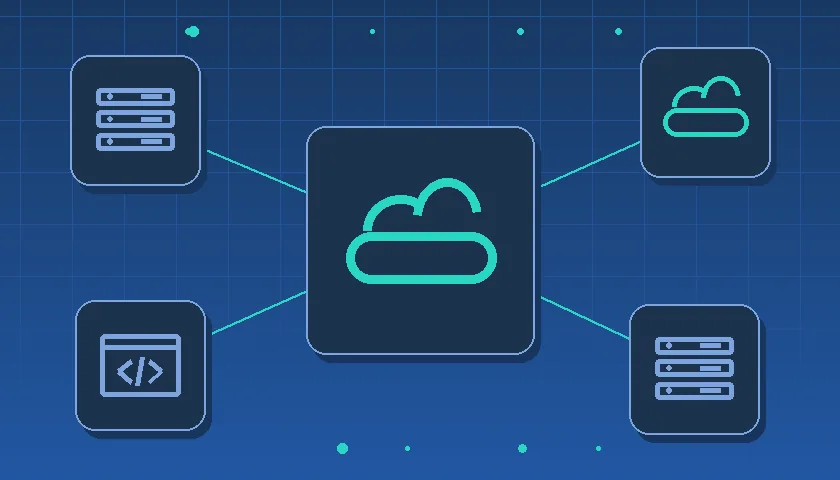
A booking site must remain usable during an isolated infrastructure interruption and serves visitors in two countries. Redundancy only helps when the dependencies and recovery process are equally resilient. This is a useful situation in which to make the technical requirements explicit before changing tools, because the choices affect day-to-day work as well as the initial setup.
Capacity and availability are related but not identical. A system can have abundant capacity and still be unavailable if an essential dependency fails. A redundant design can also perform badly if surviving components cannot handle the traffic. Treat an observed performance limit and a failure-recovery target as separate requirements and test them with appropriate workloads.
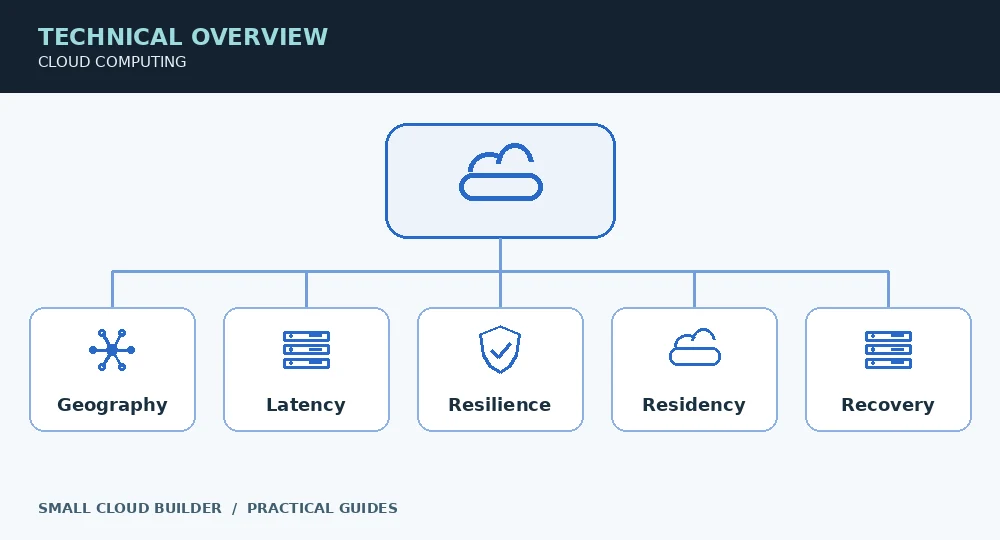
Geography
Regions are geographically grouped service locations; zones are distinct failure domains within a region. Provider designs differ.
An implementation plan should state who owns geography once the work is complete. Measure the experience from two representative cities instead of the office alone. Ask the person responsible for ongoing administration to take part in verifying the result, rather than handing them an unfamiliar setup at the end. They need to know where to find the relevant configuration, what a normal result looks like and what to do if it changes unexpectedly. Where two roles share responsibility, document the handoff. In a small organization, clear ownership and a repeatable check often prevent problems that an additional piece of software would merely make more difficult to investigate.
Treat a successful result as evidence for the particular situation that was tested. Changes to the environment can alter that behavior. A lightweight regression check after important changes makes it easier to identify when a previously dependable assumption no longer holds.
Latency
Measure request timing from representative user locations. Database round trips often matter more than geographic distance alone.
Start with what is already observable. Check whether a service's zone name maps to an independently operated location. Write down the result alongside the original expectation. A useful comparison keeps the workload and the surrounding conditions stable; differences in sample size, connection quality or a change made elsewhere in the system can otherwise distort the conclusion. The value of this check is not that it proves the entire design. It exposes whether the assumption about latency holds under a recognizable working condition, and whether somebody has enough information to repeat the observation later without reconstructing the whole experiment from memory.
Before extending the setup, identify the part that is hardest to reverse. A limited pilot lets the team address problems in that part without affecting unrelated work. Keep the dependable existing process available until the replacement has passed the checks that matter.
Resilience
Place redundant components in independent zones when supported, but check database replication behavior and failover time.
A page assembled with a dozen sequential database calls can accumulate hundreds of milliseconds when application and database are placed far apart. Moving both into the same appropriately selected region might help more than distributing only the web tier. If recovery in another region is necessary, it also needs configuration, credentials and sufficient capacity.
A demonstration can be misleading when it uses a perfectly prepared environment. The useful question is what happens during routine work. Rehearse an isolated backend interruption without exposing customers to downtime. Use an ordinary sample, with enough variation to reveal common problems but without requiring live customer records. Where behavior differs between a new environment and the existing one, establish which difference matters to the business before making a choice. Keep a record of errors and unexpected constraints as well as successes. An inconclusive test is a reason to refine the experiment, not a reason to assume that resilience has been solved.
The cost of an incorrect assumption increases as more people or records depend on it. Resolve uncertainty while the configuration is still small. A precise limitation is more useful than a general assurance that the system should probably work in a larger environment.
For another perspective on the same infrastructure or workflow decision, see Containers vs Virtual Machines. Compare the requirements it identifies with the constraints in your own environment.
Residency
Confirm where backups, logs and replicated data reside as well as primary data.
Separate the initial selection from the evidence that supports it. Verify residency of archived records, including logs and recovery copies. The test should be small enough that a mistake is reversible and sufficiently representative that the result can guide a decision. Record what direct observation establishes and what remains an assumption. For example, one successful run says little about unusual inputs or a much higher level of demand. Use the first observation to decide what another test ought to cover. As work moves from evaluation into routine operation, revisit the assumptions about residency rather than leaving them frozen in the original proposal.
It is worth writing down any restriction discovered during the check, including one that does not affect the present workload. A future maintainer may not have the same assumptions about data size, supported devices or how often the procedure needs to run.
Recovery
Document regional outage procedures, DNS dependencies and restored capacity before investing in an additional region.
For recovery, a useful comparison is one that a colleague can independently reproduce. Estimate the secondary capacity required after a complete region becomes unavailable. Describe the relevant starting conditions and save the result using consistent terminology. Avoid comparing a first-time setup in one system with an already optimized setup in another unless the difference is explicitly part of the evaluation. Make note of the effort required to reach a usable state as well as the eventual result. In a business environment, the time required to repeat a configuration, recover access or diagnose a problem is a real constraint, even when it is not reflected in a product specification.
There is no need for a large spreadsheet if a short set of observations is sufficient. The purpose is to make the decision traceable, distinguish known limitations from speculation and preserve enough information to investigate a reported problem later.
Putting the findings to work
Separate shared infrastructure costs from the demand attributable to one application. A resource that remains allocated between traffic peaks has different cost behavior from a usage-metered execution service. To compare the two, capture operating hours, data transfer, requests and retention, including resources maintained for recovery or testing. This avoids making a decision based only on the cheapest visible unit price.
For a short review before making the decision, return to the concrete checks from the guide:
- Measure the experience from two representative cities instead of the office alone.
- Check whether a service's zone name maps to an independently operated location.
- Rehearse an isolated backend interruption without exposing customers to downtime.
- Verify residency of archived records, including logs and recovery copies.
- Estimate the secondary capacity required after a complete region becomes unavailable.
Redundancy only helps when the dependencies and recovery process are equally resilient. Keep the key observations available to the people responsible for the system, with enough detail to revisit the decision when the workload, tools or business requirements change.
Related guide: Choosing a Managed Cloud Database. Compare operational boundaries, durability, scaling and query behavior before selecting a database service.
Related guide: Customer Relationship Management Software: Selection Guide. Choose a CRM around the sales and service processes actually used.