Incident Response Planning for Small Organizations
Prepare a simple process for handling suspected security incidents.
A company wants a written plan before it faces a compromised account or a lost employee device. An incident plan helps people make deliberate decisions under stress and reduces confusion about responsibilities. The following guide treats the problem as a working decision: what needs to happen, what the technology actually provides, and which observations can support a choice.
A security control addresses a particular risk, not every possible problem. Account authentication limits some unauthorized access; restricted permissions limit what an authenticated identity can do; independent recovery copies help after damaging changes. These controls complement one another. A small organization benefits from identifying sensitive systems and assigning ownership before introducing additional complexity.
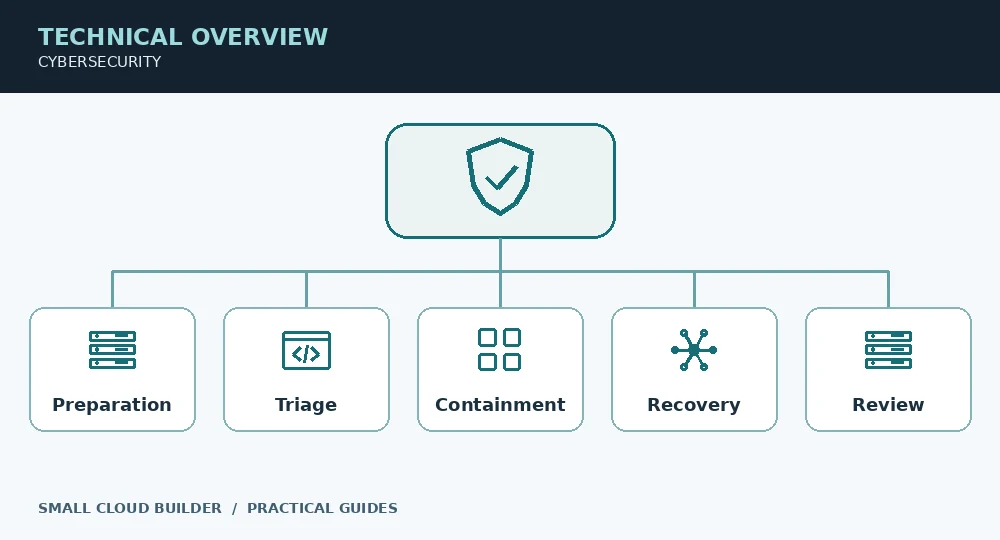
Preparation
Name decision makers, technical contacts and communication channels that remain available if primary systems fail.
There is a straightforward way to turn preparation into a decision instead of an argument about features. List decision makers and alternative contact channels for a simulated incident. Keep the result in a short working note: the starting conditions, what was changed, what actually happened and the outcome that would be acceptable in production. If the result is different from the expected behavior, isolate the cause before adding another component. This is particularly important for a small team, where the person implementing a solution is often also the person who will have to maintain it and explain a failure to colleagues.
Record a failure before changing several settings at once. A clear observation made under known conditions makes troubleshooting much easier. With multiple simultaneous changes, it may become difficult to tell which action corrected the issue or whether it merely hid the symptom.
Triage
Record observations, identify affected services and assess business impact without unnecessarily exposing sensitive records.
During a suspected account compromise, conflicting attempts to reset accounts and delete records can complicate recovery. Assign responsibility for authorized containment, preserve relevant information securely and document decisions. Separate verified observations from assumptions so that recovery steps address the actual affected systems.
Separate the initial selection from the evidence that supports it. Record when an unusual account event was observed and who was informed. The test should be small enough that a mistake is reversible and sufficiently representative that the result can guide a decision. Record what direct observation establishes and what remains an assumption. For example, one successful run says little about unusual inputs or a much higher level of demand. Use the first observation to decide what another test ought to cover. As work moves from evaluation into routine operation, revisit the assumptions about triage rather than leaving them frozen in the original proposal.
The cost of an incorrect assumption increases as more people or records depend on it. Resolve uncertainty while the configuration is still small. A precise limitation is more useful than a general assurance that the system should probably work in a larger environment.
Containment
Use authorized account and device controls to limit further harm, preserving relevant evidence and documenting actions.
The distinction becomes easier to see with an explicit acceptance test. Practice authorized suspension of a harmless test account and preserve relevant logs. Decide in advance which outcome would be a success. A measurement that looks impressive on its own may be irrelevant if the original task remains difficult or unreliable. Track failures alongside the successful result; a capability that works only when a particular person is present may be less useful than a slightly slower process anyone on the team can follow. The final choice should reflect the actual working requirements around containment, including what the team can reasonably support after the initial installation.
If the exercise requires temporary privileges or a special configuration, separate those from what the finished system actually needs. Remove temporary access when it is no longer required and document the configuration that the team expects to keep.
For another perspective on the same infrastructure or workflow decision, see Protecting Cloud Accounts and Administrative Access. Compare the requirements it identifies with the constraints in your own environment.
Recovery
Restore trustworthy operations, validate accounts and configurations, and monitor for recurrence.
Separate the initial selection from the evidence that supports it. Restore that test account to intended operation and verify access. The test should be small enough that a mistake is reversible and sufficiently representative that the result can guide a decision. Record what direct observation establishes and what remains an assumption. For example, one successful run says little about unusual inputs or a much higher level of demand. Use the first observation to decide what another test ought to cover. As work moves from evaluation into routine operation, revisit the assumptions about recovery rather than leaving them frozen in the original proposal.
Before extending the setup, identify the part that is hardest to reverse. A limited pilot lets the team address problems in that part without affecting unrelated work. Keep the dependable existing process available until the replacement has passed the checks that matter.
Review
Document lessons, outstanding work and appropriate notification decisions with qualified support when required.
A written requirement is most valuable when it can be tested without guessing what the author meant. Review the exercise for delays and unclear ownership rather than guessing the cause. Establish a meaningful threshold for the result, whether that is correctness, usable response time, preservation of records or successful access by the intended person. Do not silently revise the threshold after seeing a disappointing outcome; instead, decide whether the business requirement itself has changed. Even a modest record of test results helps a small team make later decisions about review without relying on a recollection of which option looked most convincing during the initial evaluation.
It is worth writing down any restriction discovered during the check, including one that does not affect the present workload. A future maintainer may not have the same assumptions about data size, supported devices or how often the procedure needs to run.
Review controls from both the ordinary user's and the administrator's perspectives. A recovery path that is impossible to use in a real incident may encourage unsafe workarounds. Excessive administrator permissions can also turn a routine mistake into a serious problem. The aim is a practical process that enables legitimate work while keeping sensitive actions subject to appropriate control.
Putting the findings to work
Routine maintenance provides a foundation for more complicated security work. Keep software supported, remove unnecessary access, preserve appropriate logs and test recovery procedures with authorized tools and harmless sample data. Record responsibility for following up on notices and problems. Do not assume that a product will investigate every unusual event or make decisions on behalf of the organization.
For a short review before making the decision, return to the concrete checks from the guide:
- List decision makers and alternative contact channels for a simulated incident.
- Record when an unusual account event was observed and who was informed.
- Practice authorized suspension of a harmless test account and preserve relevant logs.
- Restore that test account to intended operation and verify access.
- Review the exercise for delays and unclear ownership rather than guessing the cause.
An incident plan helps people make deliberate decisions under stress and reduces confusion about responsibilities. Keep the key observations available to the people responsible for the system, with enough detail to revisit the decision when the workload, tools or business requirements change.
Related guide: Multi-Factor Authentication and Passkeys Explained. Reduce account takeover risk while preserving safe access recovery.
Related guide: Website Uptime Monitoring and Incident Response. Track real availability and create a clear response process.