Protecting Cloud Accounts and Administrative Access
Create a manageable security baseline for cloud console and business SaaS accounts.
A startup has separate cloud hosting, billing, email and code-repository accounts with several owners. Cloud account security begins with knowing which identities can alter infrastructure, data and recovery settings. Rather than starting with a long feature list, begin with the task itself. This makes it possible to compare alternatives against a real requirement and identify responsibilities before committing to a design.
Routine maintenance provides a foundation for more complicated security work. Keep software supported, remove unnecessary access, preserve appropriate logs and test recovery procedures with authorized tools and harmless sample data. Record responsibility for following up on notices and problems. Do not assume that a product will investigate every unusual event or make decisions on behalf of the organization.
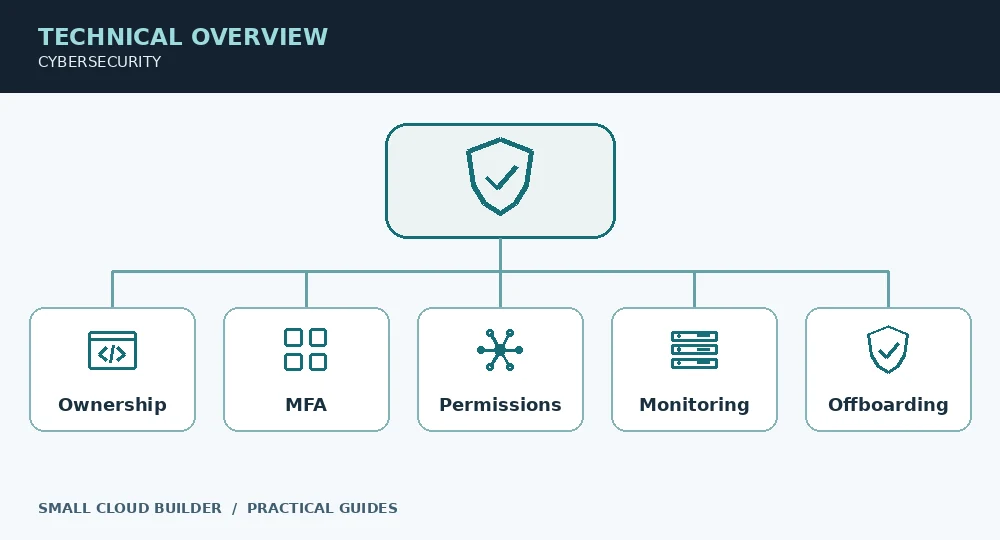
Ownership
Use business-controlled identities and documented account owners rather than personal login records.
A written requirement is most valuable when it can be tested without guessing what the author meant. List the accounts controlling billing, hosting, email and recovery services. Establish a meaningful threshold for the result, whether that is correctness, usable response time, preservation of records or successful access by the intended person. Do not silently revise the threshold after seeing a disappointing outcome; instead, decide whether the business requirement itself has changed. Even a modest record of test results helps a small team make later decisions about ownership without relying on a recollection of which option looked most convincing during the initial evaluation.
The people who carry out routine work may notice different problems from the person who set up the system. Include their observations, particularly repeated manual steps or confusing states. These details can dominate the long-term effort even when the underlying technology performs well.
MFA
Enable strong supported authentication, especially for administration, billing and recovery roles.
There is a straightforward way to turn mfa into a decision instead of an argument about features. Check enrollment of supported strong authentication in a test account. Keep the result in a short working note: the starting conditions, what was changed, what actually happened and the outcome that would be acceptable in production. If the result is different from the expected behavior, isolate the cause before adding another component. This is particularly important for a small team, where the person implementing a solution is often also the person who will have to maintain it and explain a failure to colleagues.
There is no need for a large spreadsheet if a short set of observations is sufficient. The purpose is to make the decision traceable, distinguish known limitations from speculation and preserve enough information to investigate a reported problem later.
Permissions
Restrict administrative access, use separate daily accounts where practical and review integration privileges.
An administrator responsible for billing and cloud services should not rely on a single employee's private mailbox for recovery. Use business-managed identities with documented owners, suitable strong authentication and an approved procedure for role changes. Review major account changes where consoles provide relevant activity records.
Start with what is already observable. Verify a read-only cloud role does not receive administrative permissions. Write down the result alongside the original expectation. A useful comparison keeps the workload and the surrounding conditions stable; differences in sample size, connection quality or a change made elsewhere in the system can otherwise distort the conclusion. The value of this check is not that it proves the entire design. It exposes whether the assumption about permissions holds under a recognizable working condition, and whether somebody has enough information to repeat the observation later without reconstructing the whole experiment from memory.
Avoid building the rest of the project around an undocumented assumption. The useful output here is a small record of the actual behavior and any constraints that may affect the next decision. If another person cannot interpret that record, add the missing context while it is still easy to recover.
For another perspective on the same infrastructure or workflow decision, see Cybersecurity Basics for Small Businesses. Compare the requirements it identifies with the constraints in your own environment.
Monitoring
Enable relevant account activity notices and logs, and make sure somebody reviews significant changes.
Separate the initial selection from the evidence that supports it. Review sample notifications for significant account changes. The test should be small enough that a mistake is reversible and sufficiently representative that the result can guide a decision. Record what direct observation establishes and what remains an assumption. For example, one successful run says little about unusual inputs or a much higher level of demand. Use the first observation to decide what another test ought to cover. As work moves from evaluation into routine operation, revisit the assumptions about monitoring rather than leaving them frozen in the original proposal.
When comparing choices, include the ordinary maintenance procedure as a requirement. If the team can only demonstrate a capability with extensive assistance, plan for that dependency rather than assuming the same results will be available without it.
Offboarding
Remove departing users, revoke unnecessary sessions and verify the continuity of shared business records.
A demonstration can be misleading when it uses a perfectly prepared environment. The useful question is what happens during routine work. Follow an approved test-user departure process and confirm record ownership remains intact. Use an ordinary sample, with enough variation to reveal common problems but without requiring live customer records. Where behavior differs between a new environment and the existing one, establish which difference matters to the business before making a choice. Keep a record of errors and unexpected constraints as well as successes. An inconclusive test is a reason to refine the experiment, not a reason to assume that offboarding has been solved.
Treat a successful result as evidence for the particular situation that was tested. Changes to the environment can alter that behavior. A lightweight regression check after important changes makes it easier to identify when a previously dependable assumption no longer holds.
A security control addresses a particular risk, not every possible problem. Account authentication limits some unauthorized access; restricted permissions limit what an authenticated identity can do; independent recovery copies help after damaging changes. These controls complement one another. A small organization benefits from identifying sensitive systems and assigning ownership before introducing additional complexity.
Putting the findings to work
Review controls from both the ordinary user's and the administrator's perspectives. A recovery path that is impossible to use in a real incident may encourage unsafe workarounds. Excessive administrator permissions can also turn a routine mistake into a serious problem. The aim is a practical process that enables legitimate work while keeping sensitive actions subject to appropriate control.
For a short review before making the decision, return to the concrete checks from the guide:
- List the accounts controlling billing, hosting, email and recovery services.
- Check enrollment of supported strong authentication in a test account.
- Verify a read-only cloud role does not receive administrative permissions.
- Review sample notifications for significant account changes.
- Follow an approved test-user departure process and confirm record ownership remains intact.
Cloud account security begins with knowing which identities can alter infrastructure, data and recovery settings. Keep the key observations available to the people responsible for the system, with enough detail to revisit the decision when the workload, tools or business requirements change.
Related guide: How to Create a Secure Password Policy. Design manageable account rules that avoid predictable passwords and shared credentials.
Related guide: Understanding IaaS, PaaS and SaaS. Compare the layers you operate, delegate and pay for in common cloud delivery models.