NAS vs Cloud Storage: Choosing the Right Place for Files
Compare local network storage, hosted file access and combined approaches.
A photography studio needs fast access to large images and wants off-site recovery if equipment is damaged. File placement should reflect performance, collaboration, retention and recovery requirements, not a single storage label. Rather than starting with a long feature list, begin with the task itself. This makes it possible to compare alternatives against a real requirement and identify responsibilities before committing to a design.
Storage devices and network services have different maintenance lifecycles. Disks, controllers and local applications may continue functioning after a vendor stops supporting a remote service. Avoid relying on unsupported remote access for current business operations, and keep an independently accessible copy of irreplaceable material. A migration plan should preserve the files even if the previous application cannot be installed again.
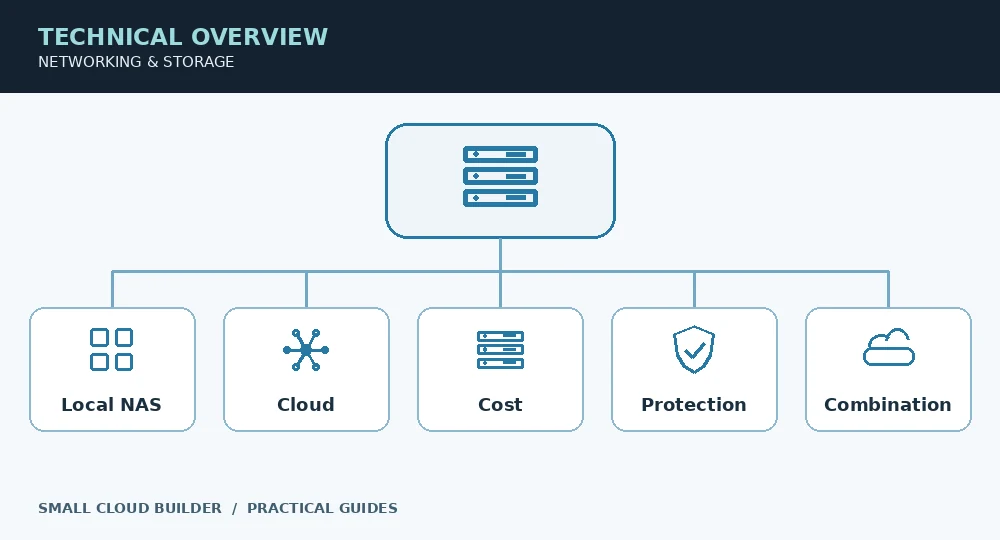
Local NAS
Network-attached storage provides shared local capacity and may work quickly over a wired LAN.
Keep a distinction between normal operation and an unusual condition. Compare copying a representative large file locally and using a hosted folder. Observe the ordinary result first, then use a controlled test environment to examine a reasonable edge case. The purpose is to understand the limitations, not to create a problem for live users. If the result cannot be reproduced, inspect the starting state and any dependencies before drawing a conclusion. The practical understanding of local nas should include both what happens when everything is working and how an operator can tell when the system has stopped meeting its intended requirement.
It is worth writing down any restriction discovered during the check, including one that does not affect the present workload. A future maintainer may not have the same assumptions about data size, supported devices or how often the procedure needs to run.
Cloud
Hosted storage can make remote collaboration easier; internet upload speed and account permissions affect access.
A written requirement is most valuable when it can be tested without guessing what the author meant. Measure real upstream throughput before planning a cloud upload. Establish a meaningful threshold for the result, whether that is correctness, usable response time, preservation of records or successful access by the intended person. Do not silently revise the threshold after seeing a disappointing outcome; instead, decide whether the business requirement itself has changed. Even a modest record of test results helps a small team make later decisions about cloud without relying on a recollection of which option looked most convincing during the initial evaluation.
Avoid building the rest of the project around an undocumented assumption. The useful output here is a small record of the actual behavior and any constraints that may affect the next decision. If another person cannot interpret that record, add the missing context while it is still easy to recover.
Cost
Compare devices, disks, power, maintenance and replacement with subscriptions and data transfer charges.
For cost, a useful comparison is one that a colleague can independently reproduce. List shared folders and permission owners in both storage models. Describe the relevant starting conditions and save the result using consistent terminology. Avoid comparing a first-time setup in one system with an already optimized setup in another unless the difference is explicitly part of the evaluation. Make note of the effort required to reach a usable state as well as the eventual result. In a business environment, the time required to repeat a configuration, recover access or diagnose a problem is a real constraint, even when it is not reflected in a product specification.
Treat a successful result as evidence for the particular situation that was tested. Changes to the environment can alter that behavior. A lightweight regression check after important changes makes it easier to identify when a previously dependable assumption no longer holds.
For another perspective on the same infrastructure or workflow decision, see Dropbox vs SugarSync: File Sync Then and Now. Compare the requirements it identifies with the constraints in your own environment.
Protection
Neither a NAS with RAID nor a synchronized folder alone is a complete backup strategy.
A studio transferring a 50 GB project over a 100 Mbps internet uplink needs roughly 67 minutes at the theoretical maximum, before overhead. A local gigabit transfer can be much faster if disks and endpoints keep up. Remote collaboration and off-site recovery justify hosted copies despite that local performance advantage.
There is a straightforward way to turn protection into a decision instead of an argument about features. Estimate recovery time for a few terabytes of records. Keep the result in a short working note: the starting conditions, what was changed, what actually happened and the outcome that would be acceptable in production. If the result is different from the expected behavior, isolate the cause before adding another component. This is particularly important for a small team, where the person implementing a solution is often also the person who will have to maintain it and explain a failure to colleagues.
If the exercise requires temporary privileges or a special configuration, separate those from what the finished system actually needs. Remove temporary access when it is no longer required and document the configuration that the team expects to keep.
Combination
Keep working files where access is efficient and maintain separated, tested recovery copies.
Separate the initial selection from the evidence that supports it. Restore a sample file from an independently retained copy. The test should be small enough that a mistake is reversible and sufficiently representative that the result can guide a decision. Record what direct observation establishes and what remains an assumption. For example, one successful run says little about unusual inputs or a much higher level of demand. Use the first observation to decide what another test ought to cover. As work moves from evaluation into routine operation, revisit the assumptions about combination rather than leaving them frozen in the original proposal.
The cost of an incorrect assumption increases as more people or records depend on it. Resolve uncertainty while the configuration is still small. A precise limitation is more useful than a general assurance that the system should probably work in a larger environment.
Putting the findings to work
Network speed, application throughput and storage performance measure different things. A nominal link speed is an upper bound for that part of the connection, not a guarantee that the source can supply or the destination can write data at the same rate. Protocol overhead, device processing, concurrent activity and the access pattern all influence the observed result. Measure the complete transfer for the files and devices that matter.
For a short review before making the decision, return to the concrete checks from the guide:
- Compare copying a representative large file locally and using a hosted folder.
- Measure real upstream throughput before planning a cloud upload.
- List shared folders and permission owners in both storage models.
- Estimate recovery time for a few terabytes of records.
- Restore a sample file from an independently retained copy.
File placement should reflect performance, collaboration, retention and recovery requirements, not a single storage label. Keep the key observations available to the people responsible for the system, with enough detail to revisit the decision when the workload, tools or business requirements change.
Related guide: AVG LiveKive and SpiderOak: The Early Cloud Backup Era. Examine the distinction between file backup, synchronization and privacy-oriented storage.
Related guide: Choosing Cloud Office Software. Compare document collaboration, storage access and administration for everyday work.