Understanding Home and Small Office Networks
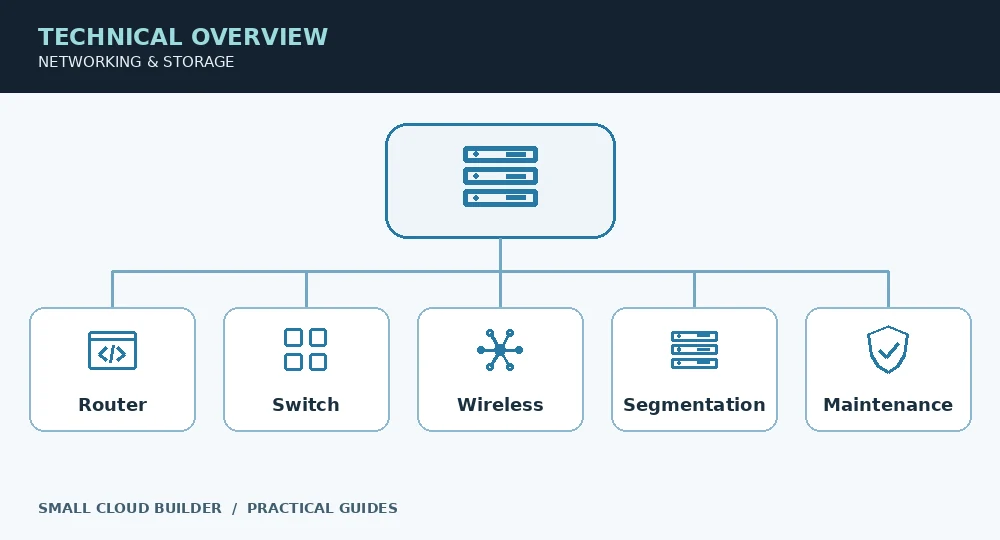
Plan reliable connectivity around routers, switches, access points and addressing.
A small office has growing numbers of computers, printers and wireless devices sharing one internet connection. A reliable small network starts with clear topology and resource needs rather than the most expensive router. The following guide treats the problem as a working decision: what needs to happen, what the technology actually provides, and which observations can support a choice.
Availability and durability solve different problems. A system that remains accessible after a disk failure may still propagate an accidental deletion or lose data during a serious equipment failure. Retained copies and tested restoration provide a different type of protection. Decide how quickly important files must become accessible and how much recent change the owner can afford to lose.
Router
The router connects networks and usually provides functions such as address assignment and internet sharing.
A demonstration can be misleading when it uses a perfectly prepared environment. The useful question is what happens during routine work. Sketch the path from a laptop to the local switch and the internet router. Use an ordinary sample, with enough variation to reveal common problems but without requiring live customer records. Where behavior differs between a new environment and the existing one, establish which difference matters to the business before making a choice. Keep a record of errors and unexpected constraints as well as successes. An inconclusive test is a reason to refine the experiment, not a reason to assume that router has been solved.
Treat a successful result as evidence for the particular situation that was tested. Changes to the environment can alter that behavior. A lightweight regression check after important changes makes it easier to identify when a previously dependable assumption no longer holds.
Switch
Wired switching connects devices on a local network and can provide more ports and dedicated link capacity.
A written requirement is most valuable when it can be tested without guessing what the author meant. Count available wired ports and identify shared uplinks. Establish a meaningful threshold for the result, whether that is correctness, usable response time, preservation of records or successful access by the intended person. Do not silently revise the threshold after seeing a disappointing outcome; instead, decide whether the business requirement itself has changed. Even a modest record of test results helps a small team make later decisions about switch without relying on a recollection of which option looked most convincing during the initial evaluation.
The people who carry out routine work may notice different problems from the person who set up the system. Include their observations, particularly repeated manual steps or confusing states. These details can dominate the long-term effort even when the underlying technology performs well.
Wireless
Access points supply radio coverage; placement, channel use and interference affect real throughput.
A printer and visitor device can share the same physical office while having different network access requirements. Where suitable equipment supports it, logical separation can limit unnecessary communication. The administrator should still verify the actual permitted connections; a label such as guest does not prove that separation is effective.
An implementation plan should state who owns wireless once the work is complete. Measure wireless performance in a meeting area with typical devices. Ask the person responsible for ongoing administration to take part in verifying the result, rather than handing them an unfamiliar setup at the end. They need to know where to find the relevant configuration, what a normal result looks like and what to do if it changes unexpectedly. Where two roles share responsibility, document the handoff. In a small organization, clear ownership and a repeatable check often prevent problems that an additional piece of software would merely make more difficult to investigate.
Before extending the setup, identify the part that is hardest to reverse. A limited pilot lets the team address problems in that part without affecting unrelated work. Keep the dependable existing process available until the replacement has passed the checks that matter.
For another perspective on the same infrastructure or workflow decision, see NAS vs Cloud Storage: Choosing the Right Place for Files. Compare the requirements it identifies with the constraints in your own environment.
Segmentation
Separate guest or untrusted equipment where supported and restrict communication according to business needs.
Separate the initial selection from the evidence that supports it. Verify guest devices cannot access restricted business resources using approved checks. The test should be small enough that a mistake is reversible and sufficiently representative that the result can guide a decision. Record what direct observation establishes and what remains an assumption. For example, one successful run says little about unusual inputs or a much higher level of demand. Use the first observation to decide what another test ought to cover. As work moves from evaluation into routine operation, revisit the assumptions about segmentation rather than leaving them frozen in the original proposal.
When comparing choices, include the ordinary maintenance procedure as a requirement. If the team can only demonstrate a capability with extensive assistance, plan for that dependency rather than assuming the same results will be available without it.
Maintenance
Document equipment, addresses and credentials; test connectivity and preserve a recovery configuration.
Separate the initial selection from the evidence that supports it. Record the equipment replacement and network recovery procedures. The test should be small enough that a mistake is reversible and sufficiently representative that the result can guide a decision. Record what direct observation establishes and what remains an assumption. For example, one successful run says little about unusual inputs or a much higher level of demand. Use the first observation to decide what another test ought to cover. As work moves from evaluation into routine operation, revisit the assumptions about maintenance rather than leaving them frozen in the original proposal.
The cost of an incorrect assumption increases as more people or records depend on it. Resolve uncertainty while the configuration is still small. A precise limitation is more useful than a general assurance that the system should probably work in a larger environment.
Putting the findings to work
Storage devices and network services have different maintenance lifecycles. Disks, controllers and local applications may continue functioning after a vendor stops supporting a remote service. Avoid relying on unsupported remote access for current business operations, and keep an independently accessible copy of irreplaceable material. A migration plan should preserve the files even if the previous application cannot be installed again.
For a short review before making the decision, return to the concrete checks from the guide:
- Sketch the path from a laptop to the local switch and the internet router.
- Count available wired ports and identify shared uplinks.
- Measure wireless performance in a meeting area with typical devices.
- Verify guest devices cannot access restricted business resources using approved checks.
- Record the equipment replacement and network recovery procedures.
A reliable small network starts with clear topology and resource needs rather than the most expensive router. Keep the key observations available to the people responsible for the system, with enough detail to revisit the decision when the workload, tools or business requirements change.
Related guide: Seagate GoFlex Home: Lessons from an Early Consumer NAS. A retrospective on local network storage and early remote file access.
Related guide: Cloud Regions and Availability Zones Explained. Plan placement around latency, service availability and regional failure boundaries.