Wi-Fi Coverage and Reliability in Small Offices
Improve wireless performance using placement, channel planning and realistic measurements.
A two-floor office has dead spots in meeting rooms and intermittent video calls near busy work areas. Consistent coverage and adequate airtime matter more than a headline wireless speed specification. The following guide treats the problem as a working decision: what needs to happen, what the technology actually provides, and which observations can support a choice.
Network speed, application throughput and storage performance measure different things. A nominal link speed is an upper bound for that part of the connection, not a guarantee that the source can supply or the destination can write data at the same rate. Protocol overhead, device processing, concurrent activity and the access pattern all influence the observed result. Measure the complete transfer for the files and devices that matter.
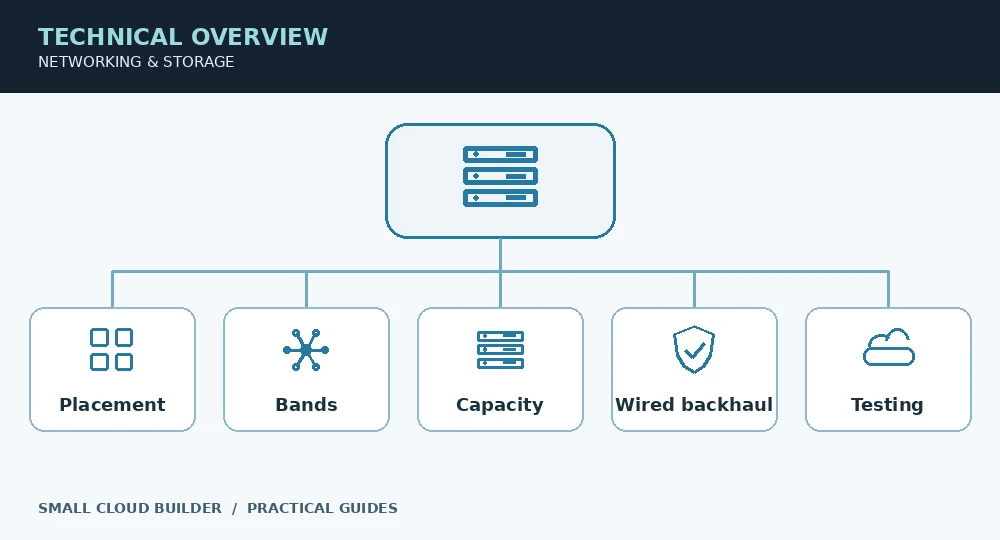
Placement
Locate access points near demand while accounting for walls, furniture and interference; avoid hiding antennas behind metal.
A written requirement is most valuable when it can be tested without guessing what the author meant. Measure signal and throughput at desks, meeting rooms and corridors. Establish a meaningful threshold for the result, whether that is correctness, usable response time, preservation of records or successful access by the intended person. Do not silently revise the threshold after seeing a disappointing outcome; instead, decide whether the business requirement itself has changed. Even a modest record of test results helps a small team make later decisions about placement without relying on a recollection of which option looked most convincing during the initial evaluation.
When comparing choices, include the ordinary maintenance procedure as a requirement. If the team can only demonstrate a capability with extensive assistance, plan for that dependency rather than assuming the same results will be available without it.
Bands
Different radio bands trade range and available channels; client capabilities influence real results.
A phone showing a strong Wi-Fi signal may still struggle to transmit because many devices contend for airtime. Moving an access point can improve coverage but not necessarily capacity. Measure real throughput and delay during a busy working period, then decide whether placement, a wired connection or additional capacity is appropriate.
Separate the initial selection from the evidence that supports it. Repeat the measurements when many ordinary clients are connected. The test should be small enough that a mistake is reversible and sufficiently representative that the result can guide a decision. Record what direct observation establishes and what remains an assumption. For example, one successful run says little about unusual inputs or a much higher level of demand. Use the first observation to decide what another test ought to cover. As work moves from evaluation into routine operation, revisit the assumptions about bands rather than leaving them frozen in the original proposal.
There is no need for a large spreadsheet if a short set of observations is sufficient. The purpose is to make the decision traceable, distinguish known limitations from speculation and preserve enough information to investigate a reported problem later.
Capacity
Many devices competing for airtime may perform poorly even when the signal looks strong.
There is a straightforward way to turn capacity into a decision instead of an argument about features. Inspect channel use before selecting different access point settings. Keep the result in a short working note: the starting conditions, what was changed, what actually happened and the outcome that would be acceptable in production. If the result is different from the expected behavior, isolate the cause before adding another component. This is particularly important for a small team, where the person implementing a solution is often also the person who will have to maintain it and explain a failure to colleagues.
Before extending the setup, identify the part that is hardest to reverse. A limited pilot lets the team address problems in that part without affecting unrelated work. Keep the dependable existing process available until the replacement has passed the checks that matter.
For another perspective on the same infrastructure or workflow decision, see Ethernet Cabling and Network Speed Basics. Compare the requirements it identifies with the constraints in your own environment.
Wired backhaul
Wired links between access points and the network can avoid consuming wireless capacity for forwarding.
A less obvious part of wired backhaul is the boundary between an individual task and the system around it. Compare a wired backhaul with a congested wireless relay path. Check the environment before and after the exercise, making sure unrelated records or settings have not changed. Record any dependencies required for success and distinguish permanent requirements from one-time setup work. A process that depends on a temporary test account, a particular device or an undocumented configuration may need additional work before it is ready for normal use. Leave room in the plan for that discovery rather than committing to a launch date on the strength of a first successful attempt.
The cost of an incorrect assumption increases as more people or records depend on it. Resolve uncertainty while the configuration is still small. A precise limitation is more useful than a general assurance that the system should probably work in a larger environment.
Testing
Measure signal, latency and throughput in representative rooms at busy times, then compare changes.
Separate the initial selection from the evidence that supports it. Record results after relocating an access point rather than relying on its indicator lights. The test should be small enough that a mistake is reversible and sufficiently representative that the result can guide a decision. Record what direct observation establishes and what remains an assumption. For example, one successful run says little about unusual inputs or a much higher level of demand. Use the first observation to decide what another test ought to cover. As work moves from evaluation into routine operation, revisit the assumptions about testing rather than leaving them frozen in the original proposal.
The people who carry out routine work may notice different problems from the person who set up the system. Include their observations, particularly repeated manual steps or confusing states. These details can dominate the long-term effort even when the underlying technology performs well.
Putting the findings to work
Availability and durability solve different problems. A system that remains accessible after a disk failure may still propagate an accidental deletion or lose data during a serious equipment failure. Retained copies and tested restoration provide a different type of protection. Decide how quickly important files must become accessible and how much recent change the owner can afford to lose.
For a short review before making the decision, return to the concrete checks from the guide:
- Measure signal and throughput at desks, meeting rooms and corridors.
- Repeat the measurements when many ordinary clients are connected.
- Inspect channel use before selecting different access point settings.
- Compare a wired backhaul with a congested wireless relay path.
- Record results after relocating an access point rather than relying on its indicator lights.
Consistent coverage and adequate airtime matter more than a headline wireless speed specification. Keep the key observations available to the people responsible for the system, with enough detail to revisit the decision when the workload, tools or business requirements change.
Related guide: Choosing Backup Storage for a Small Business. Compare removable disks, local appliances and off-site storage for recovery needs.
Related guide: How CDNs Improve Website Performance. Use edge delivery, cache policies and origin protection without serving stale private content.