Orb Live and the Early Days of Remote Media Streaming
A retrospective on accessing a home media collection from mobile devices.
A household in the early mobile streaming era wanted to watch personal video away from the home network without uploading every file first. Orb Live illustrated the difference between storing media in a cloud account and accessing files that remain under local control. This is a useful situation in which to make the technical requirements explicit before changing tools, because the choices affect day-to-day work as well as the initial setup.
Hosted software can change independently of the customer's release schedule. Updated interfaces, revised plans and integration changes may affect familiar processes. Keep documentation and data ownership arrangements current, and avoid putting irreplaceable record access behind a personal account. Evaluate an exit process during a pilot, when it is relatively straightforward to discover missing export capabilities.
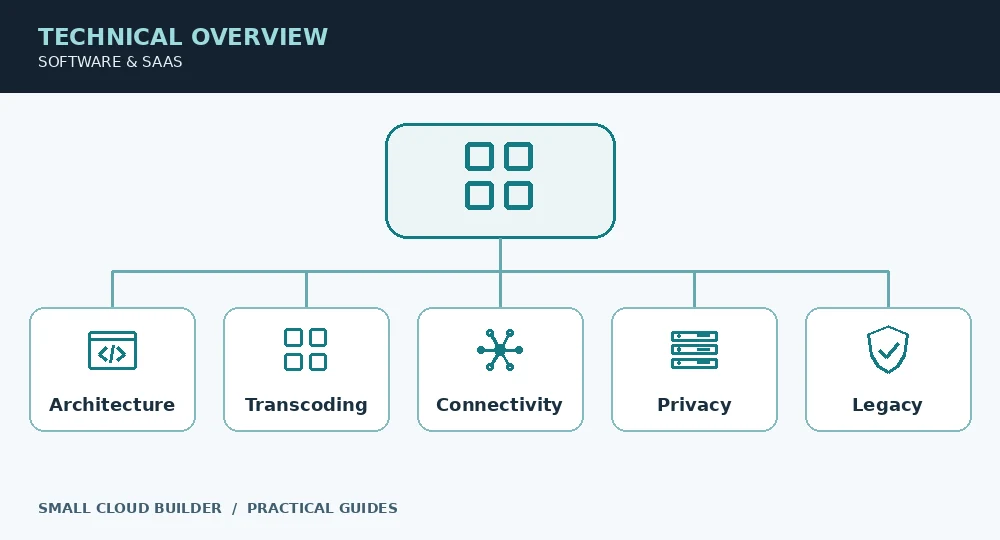
Architecture
Orb Live connected mobile playback to a media collection served by a computer or compatible system at home.
The distinction becomes easier to see with an explicit acceptance test. Estimate whether the home's upstream link could support an example video bitrate. Decide in advance which outcome would be a success. A measurement that looks impressive on its own may be irrelevant if the original task remains difficult or unreliable. Track failures alongside the successful result; a capability that works only when a particular person is present may be less useful than a slightly slower process anyone on the team can follow. The final choice should reflect the actual working requirements around architecture, including what the team can reasonably support after the initial installation.
It is worth writing down any restriction discovered during the check, including one that does not affect the present workload. A future maintainer may not have the same assumptions about data size, supported devices or how often the procedure needs to run.
Transcoding
Converting media to a compatible bitrate and format made mobile playback feasible; CPU capacity and upload speed affected results.
Separate the initial selection from the evidence that supports it. Compare compatible playback with playback requiring real-time conversion. The test should be small enough that a mistake is reversible and sufficiently representative that the result can guide a decision. Record what direct observation establishes and what remains an assumption. For example, one successful run says little about unusual inputs or a much higher level of demand. Use the first observation to decide what another test ought to cover. As work moves from evaluation into routine operation, revisit the assumptions about transcoding rather than leaving them frozen in the original proposal.
When comparing choices, include the ordinary maintenance procedure as a requirement. If the team can only demonstrate a capability with extensive assistance, plan for that dependency rather than assuming the same results will be available without it.
Connectivity
Home upstream bandwidth, availability of the serving computer and remote service dependencies limited reliability.
Start with what is already observable. Consider the consequence of the source computer going to sleep midstream. Write down the result alongside the original expectation. A useful comparison keeps the workload and the surrounding conditions stable; differences in sample size, connection quality or a change made elsewhere in the system can otherwise distort the conclusion. The value of this check is not that it proves the entire design. It exposes whether the assumption about connectivity holds under a recognizable working condition, and whether somebody has enough information to repeat the observation later without reconstructing the whole experiment from memory.
Avoid building the rest of the project around an undocumented assumption. The useful output here is a small record of the actual behavior and any constraints that may affect the next decision. If another person cannot interpret that record, add the missing context while it is still easy to recover.
For another perspective on the same infrastructure or workflow decision, see Skifta and DLNA Media Sharing: What the Experiment Taught. Compare the requirements it identifies with the constraints in your own environment.
Privacy
Remote access introduces permissions and network exposure; old software should not be presumed safe or supported today.
At a simplified bitrate of 4 megabits per second, a one-hour stream represents roughly 1.8 GB of media payload. That requires sustained home upload capacity plus overhead and a capable receiving connection. Early remote playback systems made such constraints unusually visible, especially when mobile access had limited bandwidth.
There is a straightforward way to turn privacy into a decision instead of an argument about features. Review account access and avoid connecting obsolete software to public networks. Keep the result in a short working note: the starting conditions, what was changed, what actually happened and the outcome that would be acceptable in production. If the result is different from the expected behavior, isolate the cause before adding another component. This is particularly important for a small team, where the person implementing a solution is often also the person who will have to maintain it and explain a failure to colleagues.
The people who carry out routine work may notice different problems from the person who set up the system. Include their observations, particularly repeated manual steps or confusing states. These details can dominate the long-term effort even when the underlying technology performs well.
Legacy
Modern media servers still face codec compatibility, remote authentication and adaptive playback decisions.
For legacy, a useful comparison is one that a colleague can independently reproduce. Compare local playback and remote playback requirements using current maintained tools. Describe the relevant starting conditions and save the result using consistent terminology. Avoid comparing a first-time setup in one system with an already optimized setup in another unless the difference is explicitly part of the evaluation. Make note of the effort required to reach a usable state as well as the eventual result. In a business environment, the time required to repeat a configuration, recover access or diagnose a problem is a real constraint, even when it is not reflected in a product specification.
The cost of an incorrect assumption increases as more people or records depend on it. Resolve uncertainty while the configuration is still small. A precise limitation is more useful than a general assurance that the system should probably work in a larger environment.
Putting the findings to work
Software advertised by a vendor is not necessarily the same as the configuration a business will use. Plan limits, administrator roles, supported integrations and export functions may differ. Test important workflows with representative but non-sensitive data before making the software central to the organization. Note who will own the subscription and how shared records survive changes in personnel.
For a short review before making the decision, return to the concrete checks from the guide:
- Estimate whether the home's upstream link could support an example video bitrate.
- Compare compatible playback with playback requiring real-time conversion.
- Consider the consequence of the source computer going to sleep midstream.
- Review account access and avoid connecting obsolete software to public networks.
- Compare local playback and remote playback requirements using current maintained tools.
Orb Live illustrated the difference between storing media in a cloud account and accessing files that remain under local control. Keep the key observations available to the people responsible for the system, with enough detail to revisit the decision when the workload, tools or business requirements change.
Related guide: SaaS Data Portability and Exit Planning. Evaluate exports, integrations and continuity before a subscription becomes critical.
Related guide: Seagate GoFlex Home: Lessons from an Early Consumer NAS. A retrospective on local network storage and early remote file access.