AI Chatbots for Business Websites
Design a support assistant with a narrow purpose, reliable fallback and measurable results.
A service company wants visitors to find opening hours, product details and ordinary troubleshooting guidance. A useful chatbot makes reliable information easier to find and does not pretend to know answers it lacks. This is a useful situation in which to make the technical requirements explicit before changing tools, because the choices affect day-to-day work as well as the initial setup.
Information submitted to a model is part of the application's data flow. It may pass through integrations, logs, retrieval indexes or review interfaces, each with its own access requirements. Identify the information the task actually needs and the people or systems that can see it. Data minimization and careful permissions should be designed into the workflow rather than applied after a system has accumulated records.
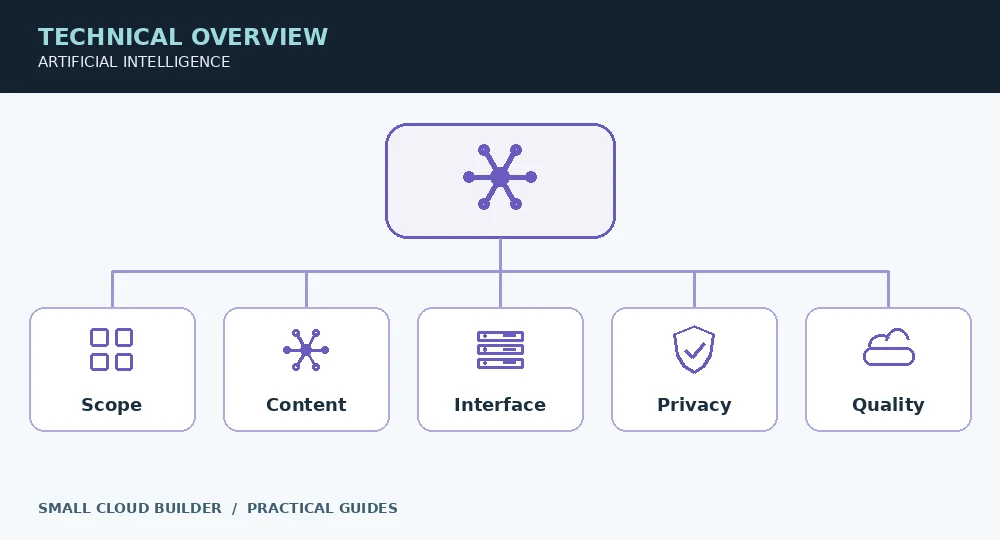
Scope
Document questions the assistant can answer and situations requiring a person; avoid commitments outside approved policies.
Start with what is already observable. List the ten most ordinary visitor questions and their verified source content. Write down the result alongside the original expectation. A useful comparison keeps the workload and the surrounding conditions stable; differences in sample size, connection quality or a change made elsewhere in the system can otherwise distort the conclusion. The value of this check is not that it proves the entire design. It exposes whether the assumption about scope holds under a recognizable working condition, and whether somebody has enough information to repeat the observation later without reconstructing the whole experiment from memory.
It is worth writing down any restriction discovered during the check, including one that does not affect the present workload. A future maintainer may not have the same assumptions about data size, supported devices or how often the procedure needs to run.
Content
Maintain a small verified knowledge collection and refresh outdated information during product changes.
Separate the initial selection from the evidence that supports it. Test a question outside the approved support scope and check the fallback behavior. The test should be small enough that a mistake is reversible and sufficiently representative that the result can guide a decision. Record what direct observation establishes and what remains an assumption. For example, one successful run says little about unusual inputs or a much higher level of demand. Use the first observation to decide what another test ought to cover. As work moves from evaluation into routine operation, revisit the assumptions about content rather than leaving them frozen in the original proposal.
The cost of an incorrect assumption increases as more people or records depend on it. Resolve uncertainty while the configuration is still small. A precise limitation is more useful than a general assurance that the system should probably work in a larger environment.
Interface
Clearly identify automated responses, provide accessible controls and let users exit or change direction.
A visitor asking whether a particular service is offered should get an answer grounded in the company's current service description. A visitor requesting an arbitrary discount needs a clear limitation or human referral. Without those boundaries, fluent responses risk creating commitments that the business never approved.
There is a straightforward way to turn interface into a decision instead of an argument about features. Ask a tester to correct a misunderstood request using the interface. Keep the result in a short working note: the starting conditions, what was changed, what actually happened and the outcome that would be acceptable in production. If the result is different from the expected behavior, isolate the cause before adding another component. This is particularly important for a small team, where the person implementing a solution is often also the person who will have to maintain it and explain a failure to colleagues.
Treat a successful result as evidence for the particular situation that was tested. Changes to the environment can alter that behavior. A lightweight regression check after important changes makes it easier to identify when a previously dependable assumption no longer holds.
For another perspective on the same infrastructure or workflow decision, see AI API Costs: Estimating Tokens and Usage. Compare the requirements it identifies with the constraints in your own environment.
Privacy
Minimize collection of personal information and define data retention and access rules before launch.
In the planning stage, avoid treating privacy as a feature checkbox. Review whether collected information is truly required for answering the question. This gives the team a real starting point for comparison. Note how much setup and administrative effort the task requires, and whether the result can be repeated without relying on special access unavailable to ordinary users. If the proposed system changes the way a person completes their work, try the new process from that role's perspective as well. The aim is to establish what is possible with the configuration you will actually operate, rather than what is possible in an ideal demonstration.
The people who carry out routine work may notice different problems from the person who set up the system. Include their observations, particularly repeated manual steps or confusing states. These details can dominate the long-term effort even when the underlying technology performs well.
Quality
Review unresolved queries, factual errors and time to resolution; use those findings to improve content.
A demonstration can be misleading when it uses a perfectly prepared environment. The useful question is what happens during routine work. Measure resolved and unresolved test queries independently of total conversations. Use an ordinary sample, with enough variation to reveal common problems but without requiring live customer records. Where behavior differs between a new environment and the existing one, establish which difference matters to the business before making a choice. Keep a record of errors and unexpected constraints as well as successes. An inconclusive test is a reason to refine the experiment, not a reason to assume that quality has been solved.
Record a failure before changing several settings at once. A clear observation made under known conditions makes troubleshooting much easier. With multiple simultaneous changes, it may become difficult to tell which action corrected the issue or whether it merely hid the symptom.
Putting the findings to work
The useful cost measure for an AI workflow includes the effort needed to verify and correct results. Consider the average output, the uncommon difficult input and the consequences of an incorrect answer separately. An inexpensive automated draft that takes longer to repair than producing the original work does not provide a useful efficiency gain.
For a short review before making the decision, return to the concrete checks from the guide:
- List the ten most ordinary visitor questions and their verified source content.
- Test a question outside the approved support scope and check the fallback behavior.
- Ask a tester to correct a misunderstood request using the interface.
- Review whether collected information is truly required for answering the question.
- Measure resolved and unresolved test queries independently of total conversations.
A useful chatbot makes reliable information easier to find and does not pretend to know answers it lacks. Keep the key observations available to the people responsible for the system, with enough detail to revisit the decision when the workload, tools or business requirements change.
Related guide: How to Evaluate AI-Generated Answers. Build a repeatable evaluation set for accuracy, completeness and useful uncertainty.
Related guide: HTML Semantic Structure for Better Websites. Build accessible documents with meaningful elements and reliable navigation.