How Large Language Models Process Text
Understand tokens, context, prediction and limitations without mathematical prerequisites.
A product manager wants to understand why an AI assistant sometimes loses details from long conversations. Language models are useful text-processing systems, but critical facts still need independent verification. The following guide treats the problem as a working decision: what needs to happen, what the technology actually provides, and which observations can support a choice.
The useful cost measure for an AI workflow includes the effort needed to verify and correct results. Consider the average output, the uncommon difficult input and the consequences of an incorrect answer separately. An inexpensive automated draft that takes longer to repair than producing the original work does not provide a useful efficiency gain.
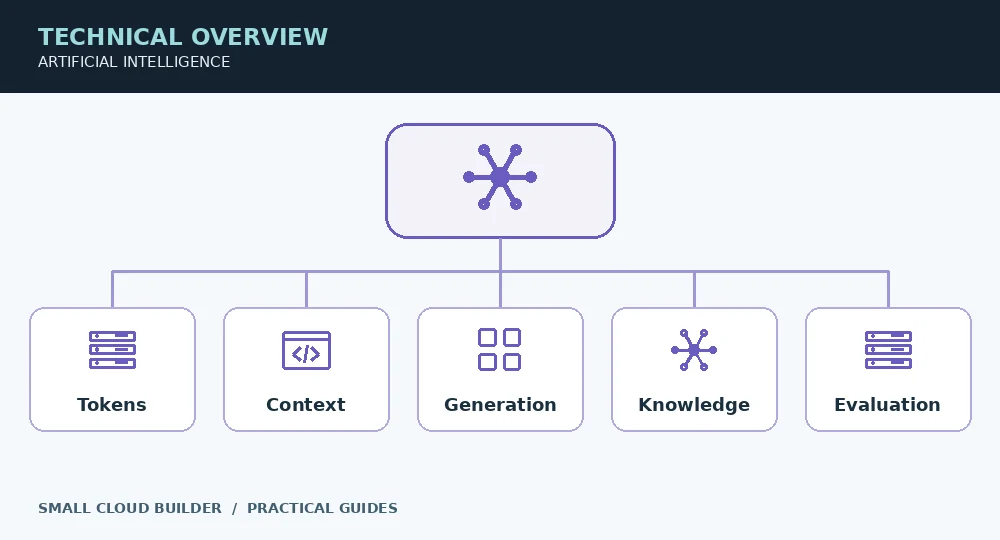
Tokens
Text is split into model-specific units, including parts of words; token counts differ across tokenizers.
Start with what is already observable. Compare token counts for short text and technical identifiers with a suitable tokenizer. Write down the result alongside the original expectation. A useful comparison keeps the workload and the surrounding conditions stable; differences in sample size, connection quality or a change made elsewhere in the system can otherwise distort the conclusion. The value of this check is not that it proves the entire design. It exposes whether the assumption about tokens holds under a recognizable working condition, and whether somebody has enough information to repeat the observation later without reconstructing the whole experiment from memory.
The people who carry out routine work may notice different problems from the person who set up the system. Include their observations, particularly repeated manual steps or confusing states. These details can dominate the long-term effort even when the underlying technology performs well.
Context
Models operate within a bounded input and output window, so long histories can require summarization or retrieval.
Separate the initial selection from the evidence that supports it. Observe how a very long document affects space left for the generated answer. The test should be small enough that a mistake is reversible and sufficiently representative that the result can guide a decision. Record what direct observation establishes and what remains an assumption. For example, one successful run says little about unusual inputs or a much higher level of demand. Use the first observation to decide what another test ought to cover. As work moves from evaluation into routine operation, revisit the assumptions about context rather than leaving them frozen in the original proposal.
There is no need for a large spreadsheet if a short set of observations is sufficient. The purpose is to make the decision traceable, distinguish known limitations from speculation and preserve enough information to investigate a reported problem later.
Generation
The model predicts the next token using its learned parameters and provided context; sampled outputs can vary.
In the planning stage, avoid treating generation as a feature checkbox. Run a harmless repeated request and inspect differences in wording and content. This gives the team a real starting point for comparison. Note how much setup and administrative effort the task requires, and whether the result can be repeated without relying on special access unavailable to ordinary users. If the proposed system changes the way a person completes their work, try the new process from that role's perspective as well. The aim is to establish what is possible with the configuration you will actually operate, rather than what is possible in an ideal demonstration.
Treat a successful result as evidence for the particular situation that was tested. Changes to the environment can alter that behavior. A lightweight regression check after important changes makes it easier to identify when a previously dependable assumption no longer holds.
For another perspective on the same infrastructure or workflow decision, see Retrieval-Augmented Generation for Company Knowledge. Compare the requirements it identifies with the constraints in your own environment.
Knowledge
Fluent text is not proof of reliable factual recall, especially for new or obscure information.
When a document and conversation history approach the usable context limit, the model may not receive earlier details in full. Summarization or selective retrieval can preserve important facts, but both can omit information. A system should track what material is actually included rather than assuming the whole discussion is always available.
Separate the initial selection from the evidence that supports it. Check claims about unfamiliar facts against an independently available source. The test should be small enough that a mistake is reversible and sufficiently representative that the result can guide a decision. Record what direct observation establishes and what remains an assumption. For example, one successful run says little about unusual inputs or a much higher level of demand. Use the first observation to decide what another test ought to cover. As work moves from evaluation into routine operation, revisit the assumptions about knowledge rather than leaving them frozen in the original proposal.
Avoid building the rest of the project around an undocumented assumption. The useful output here is a small record of the actual behavior and any constraints that may affect the next decision. If another person cannot interpret that record, add the missing context while it is still easy to recover.
Evaluation
Test expected tasks using a representative set, distinguish accuracy from tone and inspect corrections.
A demonstration can be misleading when it uses a perfectly prepared environment. The useful question is what happens during routine work. Define a small set of questions with known expected answers. Use an ordinary sample, with enough variation to reveal common problems but without requiring live customer records. Where behavior differs between a new environment and the existing one, establish which difference matters to the business before making a choice. Keep a record of errors and unexpected constraints as well as successes. An inconclusive test is a reason to refine the experiment, not a reason to assume that evaluation has been solved.
If the exercise requires temporary privileges or a special configuration, separate those from what the finished system actually needs. Remove temporary access when it is no longer required and document the configuration that the team expects to keep.
Putting the findings to work
A model's fluent response does not establish the truth of its claims. Generated text depends on the supplied information, model behavior and the application's retrieval or instruction design. Separate the quality of the language from factual accuracy, and make a clear distinction between a proposed draft and an approved result. A test set with known answers helps expose errors that a convincing demonstration can hide.
For a short review before making the decision, return to the concrete checks from the guide:
- Compare token counts for short text and technical identifiers with a suitable tokenizer.
- Observe how a very long document affects space left for the generated answer.
- Run a harmless repeated request and inspect differences in wording and content.
- Check claims about unfamiliar facts against an independently available source.
- Define a small set of questions with known expected answers.
Language models are useful text-processing systems, but critical facts still need independent verification. Keep the key observations available to the people responsible for the system, with enough detail to revisit the decision when the workload, tools or business requirements change.
Related guide: AI API Costs: Estimating Tokens and Usage. Forecast text model expenses without relying on a single per-request price.
Related guide: Cloud Computing for Small Businesses: Where to Start. Choose the right first cloud services without inheriting a complicated infrastructure bill.