Public Cloud vs Private Cloud vs Hybrid Cloud
Understand which deployment model suits workloads, compliance and operational resources.
A manufacturer needs an internet-facing ordering system while its factory controls remain on a separate local network. Choose the model by workload requirements rather than treating a single deployment pattern as a company-wide rule. The details matter more than product labels. The challenge is to understand which parts of the system the business depends on, where the limits are and how to check the proposed approach under realistic conditions.
Capacity and availability are related but not identical. A system can have abundant capacity and still be unavailable if an essential dependency fails. A redundant design can also perform badly if surviving components cannot handle the traffic. Treat an observed performance limit and a failure-recovery target as separate requirements and test them with appropriate workloads.
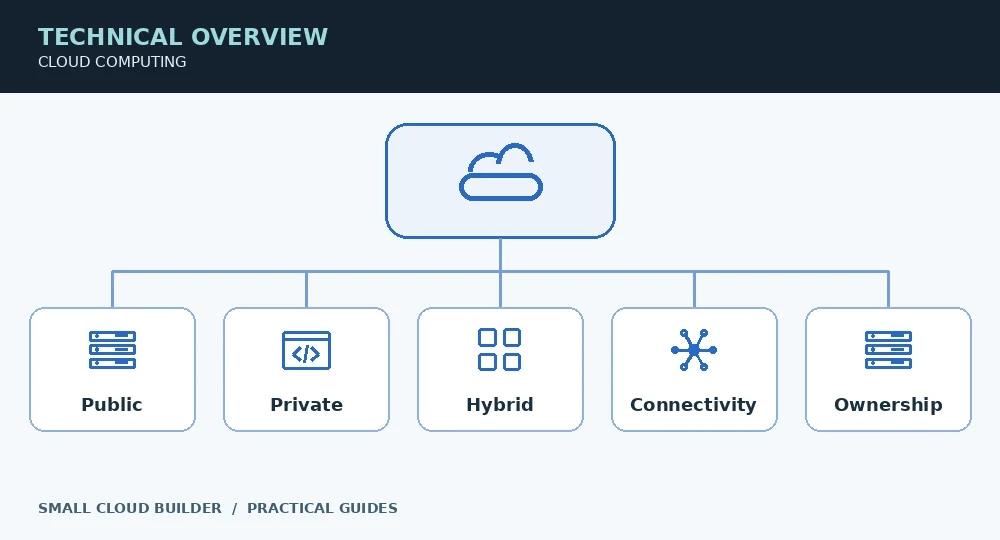
Public
Managed capacity reduces hardware work and offers elastic resources; account governance and variable consumption still need oversight.
Separate the initial selection from the evidence that supports it. Identify which local machine contains data that must remain on-site. The test should be small enough that a mistake is reversible and sufficiently representative that the result can guide a decision. Record what direct observation establishes and what remains an assumption. For example, one successful run says little about unusual inputs or a much higher level of demand. Use the first observation to decide what another test ought to cover. As work moves from evaluation into routine operation, revisit the assumptions about public rather than leaving them frozen in the original proposal.
There is no need for a large spreadsheet if a short set of observations is sufficient. The purpose is to make the decision traceable, distinguish known limitations from speculation and preserve enough information to investigate a reported problem later.
Private
Dedicated infrastructure gives control of physical placement, maintenance windows and network boundaries but needs staff and replacement capacity.
Separate the initial selection from the evidence that supports it. Count the time needed to provision and patch a spare private host. The test should be small enough that a mistake is reversible and sufficiently representative that the result can guide a decision. Record what direct observation establishes and what remains an assumption. For example, one successful run says little about unusual inputs or a much higher level of demand. Use the first observation to decide what another test ought to cover. As work moves from evaluation into routine operation, revisit the assumptions about private rather than leaving them frozen in the original proposal.
Record a failure before changing several settings at once. A clear observation made under known conditions makes troubleshooting much easier. With multiple simultaneous changes, it may become difficult to tell which action corrected the issue or whether it merely hid the symptom.
Hybrid
Keep a local data source or application where required and connect selected services through deliberately limited interfaces.
The factory system might expose only order status through a controlled interface, while personal account details and public pages live in the hosted service. During an outage, a queue can retain pending changes rather than forcing the factory application to accept traffic directly from the internet. That separates a connectivity failure from a failure of the whole business.
A written requirement is most valuable when it can be tested without guessing what the author meant. Measure a representative request crossing the boundary between local and hosted workloads. Establish a meaningful threshold for the result, whether that is correctness, usable response time, preservation of records or successful access by the intended person. Do not silently revise the threshold after seeing a disappointing outcome; instead, decide whether the business requirement itself has changed. Even a modest record of test results helps a small team make later decisions about hybrid without relying on a recollection of which option looked most convincing during the initial evaluation.
It is worth writing down any restriction discovered during the check, including one that does not affect the present workload. A future maintainer may not have the same assumptions about data size, supported devices or how often the procedure needs to run.
For another perspective on the same infrastructure or workflow decision, see Understanding IaaS, PaaS and SaaS. Compare the requirements it identifies with the constraints in your own environment.
Connectivity
Measure bandwidth, round-trip latency and duplicate transmission costs. A cloud application can fail independently of the local system.
The distinction becomes easier to see with an explicit acceptance test. Simulate the local connection becoming unavailable in a controlled test. Decide in advance which outcome would be a success. A measurement that looks impressive on its own may be irrelevant if the original task remains difficult or unreliable. Track failures alongside the successful result; a capability that works only when a particular person is present may be less useful than a slightly slower process anyone on the team can follow. The final choice should reflect the actual working requirements around connectivity, including what the team can reasonably support after the initial installation.
The cost of an incorrect assumption increases as more people or records depend on it. Resolve uncertainty while the configuration is still small. A precise limitation is more useful than a general assurance that the system should probably work in a larger environment.
Ownership
Document responsibility for hypervisors, operating systems, identities and application backups. A private cloud is not automatically secure.
In the planning stage, avoid treating ownership as a feature checkbox. Compare the cost of retaining duplicate operating skills in both environments. This gives the team a real starting point for comparison. Note how much setup and administrative effort the task requires, and whether the result can be repeated without relying on special access unavailable to ordinary users. If the proposed system changes the way a person completes their work, try the new process from that role's perspective as well. The aim is to establish what is possible with the configuration you will actually operate, rather than what is possible in an ideal demonstration.
Treat a successful result as evidence for the particular situation that was tested. Changes to the environment can alter that behavior. A lightweight regression check after important changes makes it easier to identify when a previously dependable assumption no longer holds.
Putting the findings to work
Separate shared infrastructure costs from the demand attributable to one application. A resource that remains allocated between traffic peaks has different cost behavior from a usage-metered execution service. To compare the two, capture operating hours, data transfer, requests and retention, including resources maintained for recovery or testing. This avoids making a decision based only on the cheapest visible unit price.
For a short review before making the decision, return to the concrete checks from the guide:
- Identify which local machine contains data that must remain on-site.
- Count the time needed to provision and patch a spare private host.
- Measure a representative request crossing the boundary between local and hosted workloads.
- Simulate the local connection becoming unavailable in a controlled test.
- Compare the cost of retaining duplicate operating skills in both environments.
Choose the model by workload requirements rather than treating a single deployment pattern as a company-wide rule. Keep the key observations available to the people responsible for the system, with enough detail to revisit the decision when the workload, tools or business requirements change.
Related guide: Cloud Regions and Availability Zones Explained. Plan placement around latency, service availability and regional failure boundaries.
Related guide: Local AI Models vs Hosted AI Services. Compare infrastructure ownership, model quality, privacy and operational effort.