Retrieval-Augmented Generation for Company Knowledge
Connect model answers to a controlled collection of relevant documents.

An internal support assistant should answer questions from a company policy library rather than invent procedures. Retrieval improves access to information but does not automatically resolve conflicting policies or fabricated conclusions. Rather than starting with a long feature list, begin with the task itself. This makes it possible to compare alternatives against a real requirement and identify responsibilities before committing to a design.
A model's fluent response does not establish the truth of its claims. Generated text depends on the supplied information, model behavior and the application's retrieval or instruction design. Separate the quality of the language from factual accuracy, and make a clear distinction between a proposed draft and an approved result. A test set with known answers helps expose errors that a convincing demonstration can hide.
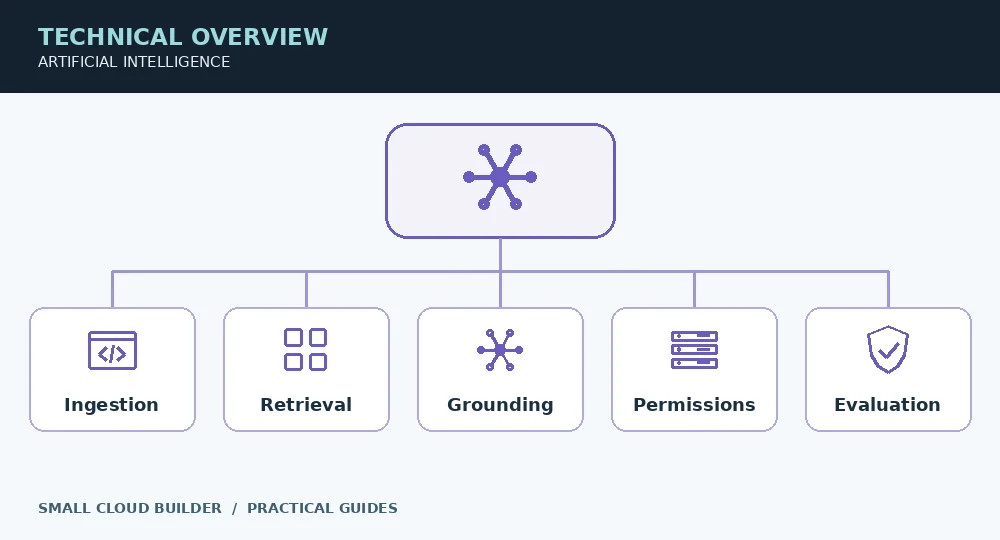
Ingestion
Clean documents and record metadata, versions, owners and access restrictions before indexing.
A less obvious part of ingestion is the boundary between an individual task and the system around it. Index two versions of a sample policy and confirm the current version ranks appropriately. Check the environment before and after the exercise, making sure unrelated records or settings have not changed. Record any dependencies required for success and distinguish permanent requirements from one-time setup work. A process that depends on a temporary test account, a particular device or an undocumented configuration may need additional work before it is ready for normal use. Leave room in the plan for that discovery rather than committing to a launch date on the strength of a first successful attempt.
The cost of an incorrect assumption increases as more people or records depend on it. Resolve uncertainty while the configuration is still small. A precise limitation is more useful than a general assurance that the system should probably work in a larger environment.
Retrieval
Select relevant passages using text matching, vector similarity or a combined strategy; passage length affects recall.
An assistant retrieving an old remote-work policy and a revised one may generate a plausible answer blending incompatible rules. Include version and effective-date metadata, prioritize authoritative records and identify conflicting sources for review. A well-maintained index and access policy are part of the application, not merely preprocessing.
For retrieval, a useful comparison is one that a colleague can independently reproduce. Test a question that cannot be answered from the approved document collection. Describe the relevant starting conditions and save the result using consistent terminology. Avoid comparing a first-time setup in one system with an already optimized setup in another unless the difference is explicitly part of the evaluation. Make note of the effort required to reach a usable state as well as the eventual result. In a business environment, the time required to repeat a configuration, recover access or diagnose a problem is a real constraint, even when it is not reflected in a product specification.
If the exercise requires temporary privileges or a special configuration, separate those from what the finished system actually needs. Remove temporary access when it is no longer required and document the configuration that the team expects to keep.
Grounding
Ask the model to distinguish retrieved evidence from uncertainty and cite internal document identifiers in answers.
Separate the initial selection from the evidence that supports it. Verify that a restricted sample document is not returned to an unauthorized test role. The test should be small enough that a mistake is reversible and sufficiently representative that the result can guide a decision. Record what direct observation establishes and what remains an assumption. For example, one successful run says little about unusual inputs or a much higher level of demand. Use the first observation to decide what another test ought to cover. As work moves from evaluation into routine operation, revisit the assumptions about grounding rather than leaving them frozen in the original proposal.
Record a failure before changing several settings at once. A clear observation made under known conditions makes troubleshooting much easier. With multiple simultaneous changes, it may become difficult to tell which action corrected the issue or whether it merely hid the symptom.
For another perspective on the same infrastructure or workflow decision, see AI Chatbots for Business Websites. Compare the requirements it identifies with the constraints in your own environment.
Permissions
Enforce access during retrieval, not just after a model receives potentially confidential text.
There is a straightforward way to turn permissions into a decision instead of an argument about features. Inspect retrieval results separately from the model's generated text. Keep the result in a short working note: the starting conditions, what was changed, what actually happened and the outcome that would be acceptable in production. If the result is different from the expected behavior, isolate the cause before adding another component. This is particularly important for a small team, where the person implementing a solution is often also the person who will have to maintain it and explain a failure to colleagues.
There is no need for a large spreadsheet if a short set of observations is sufficient. The purpose is to make the decision traceable, distinguish known limitations from speculation and preserve enough information to investigate a reported problem later.
Evaluation
Test supported and unsupported questions, stale documents and inconsistent passages, with human-reviewed expected answers.
A written requirement is most valuable when it can be tested without guessing what the author meant. Ask a reviewer to verify answer statements against retrieved passages. Establish a meaningful threshold for the result, whether that is correctness, usable response time, preservation of records or successful access by the intended person. Do not silently revise the threshold after seeing a disappointing outcome; instead, decide whether the business requirement itself has changed. Even a modest record of test results helps a small team make later decisions about evaluation without relying on a recollection of which option looked most convincing during the initial evaluation.
It is worth writing down any restriction discovered during the check, including one that does not affect the present workload. A future maintainer may not have the same assumptions about data size, supported devices or how often the procedure needs to run.
Putting the findings to work
Information submitted to a model is part of the application's data flow. It may pass through integrations, logs, retrieval indexes or review interfaces, each with its own access requirements. Identify the information the task actually needs and the people or systems that can see it. Data minimization and careful permissions should be designed into the workflow rather than applied after a system has accumulated records.
For a short review before making the decision, return to the concrete checks from the guide:
- Index two versions of a sample policy and confirm the current version ranks appropriately.
- Test a question that cannot be answered from the approved document collection.
- Verify that a restricted sample document is not returned to an unauthorized test role.
- Inspect retrieval results separately from the model's generated text.
- Ask a reviewer to verify answer statements against retrieved passages.
Retrieval improves access to information but does not automatically resolve conflicting policies or fabricated conclusions. Keep the key observations available to the people responsible for the system, with enough detail to revisit the decision when the workload, tools or business requirements change.
Related guide: Local AI Models vs Hosted AI Services. Compare infrastructure ownership, model quality, privacy and operational effort.
Related guide: Public Cloud vs Private Cloud vs Hybrid Cloud. Understand which deployment model suits workloads, compliance and operational resources.