Cloud Computing for Small Businesses: Where to Start
Choose the right first cloud services without inheriting a complicated infrastructure bill.
A ten-person design agency is moving shared work and a client portal off an office computer. It needs predictable access, a clear owner and a practical way to recover files. A useful first cloud environment has fewer services, named owners and a tested exit path. This is a useful situation in which to make the technical requirements explicit before changing tools, because the choices affect day-to-day work as well as the initial setup.
Cloud infrastructure splits responsibility across multiple control layers. Physical facilities, network services, guest systems, managed runtimes, application configuration and data can all have different operators. A hosting invoice may list a resource that looks self-contained even though it depends on identity services, DNS, monitoring and recovery storage. Draw the few boundaries that matter for this workload first. In the event of a problem, they are often more useful than a diagram showing every available cloud service.
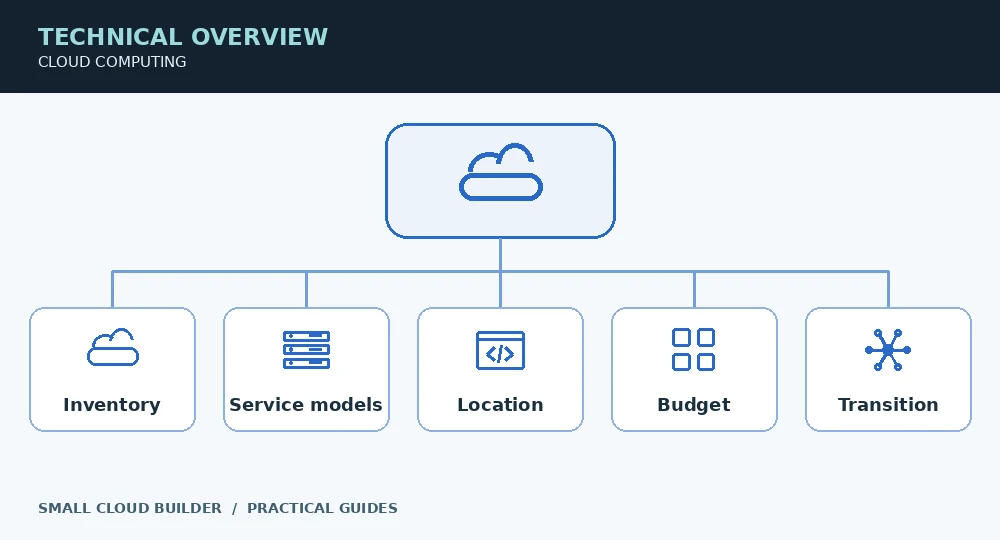
Inventory
Separate the public website, shared documents, accounting data and employee identities. Each has different availability and access requirements.
Separate the initial selection from the evidence that supports it. Draw a simple dependency map with each data set and the person who maintains it. The test should be small enough that a mistake is reversible and sufficiently representative that the result can guide a decision. Record what direct observation establishes and what remains an assumption. For example, one successful run says little about unusual inputs or a much higher level of demand. Use the first observation to decide what another test ought to cover. As work moves from evaluation into routine operation, revisit the assumptions about inventory rather than leaving them frozen in the original proposal.
The people who carry out routine work may notice different problems from the person who set up the system. Include their observations, particularly repeated manual steps or confusing states. These details can dominate the long-term effort even when the underlying technology performs well.
Service models
Use hosted software for routine work before selecting rented virtual machines. A managed database removes patching but still requires access control and backups.
The first deployment could be limited to an externally hosted website and a shared document workspace, leaving accounting untouched. Compare the old machine's annual electricity, replacement and maintenance effort against the subscriptions. Keep a local export of completed client projects; the ability to leave a service matters even when there is no intention to leave.
In the planning stage, avoid treating service models as a feature checkbox. Compare three months of licenses against the time spent maintaining the old shared machine. This gives the team a real starting point for comparison. Note how much setup and administrative effort the task requires, and whether the result can be repeated without relying on special access unavailable to ordinary users. If the proposed system changes the way a person completes their work, try the new process from that role's perspective as well. The aim is to establish what is possible with the configuration you will actually operate, rather than what is possible in an ideal demonstration.
The cost of an incorrect assumption increases as more people or records depend on it. Resolve uncertainty while the configuration is still small. A precise limitation is more useful than a general assurance that the system should probably work in a larger environment.
Location
Place latency-sensitive services near their users and check data residency requirements. A second region adds cost and complexity.
A demonstration can be misleading when it uses a perfectly prepared environment. The useful question is what happens during routine work. Check whether a representative user can open a client file from a different office. Use an ordinary sample, with enough variation to reveal common problems but without requiring live customer records. Where behavior differs between a new environment and the existing one, establish which difference matters to the business before making a choice. Keep a record of errors and unexpected constraints as well as successes. An inconclusive test is a reason to refine the experiment, not a reason to assume that location has been solved.
Treat a successful result as evidence for the particular situation that was tested. Changes to the environment can alter that behavior. A lightweight regression check after important changes makes it easier to identify when a previously dependable assumption no longer holds.
For another perspective on the same infrastructure or workflow decision, see Public Cloud vs Private Cloud vs Hybrid Cloud. Compare the requirements it identifies with the constraints in your own environment.
Budget
Estimate compute, storage, requests, outbound data and support independently. Set alerts against a monthly ceiling.
There is a straightforward way to turn budget into a decision instead of an argument about features. Estimate a month with one unusually busy week and include export traffic. Keep the result in a short working note: the starting conditions, what was changed, what actually happened and the outcome that would be acceptable in production. If the result is different from the expected behavior, isolate the cause before adding another component. This is particularly important for a small team, where the person implementing a solution is often also the person who will have to maintain it and explain a failure to colleagues.
It is worth writing down any restriction discovered during the check, including one that does not affect the present workload. A future maintainer may not have the same assumptions about data size, supported devices or how often the procedure needs to run.
Transition
Move one reversible workload first. Confirm login, export, recovery and billing before switching the remaining users.
Start with what is already observable. Restore a sample project without using the old computer as an intermediary. Write down the result alongside the original expectation. A useful comparison keeps the workload and the surrounding conditions stable; differences in sample size, connection quality or a change made elsewhere in the system can otherwise distort the conclusion. The value of this check is not that it proves the entire design. It exposes whether the assumption about transition holds under a recognizable working condition, and whether somebody has enough information to repeat the observation later without reconstructing the whole experiment from memory.
There is no need for a large spreadsheet if a short set of observations is sufficient. The purpose is to make the decision traceable, distinguish known limitations from speculation and preserve enough information to investigate a reported problem later.
Putting the findings to work
Capacity and availability are related but not identical. A system can have abundant capacity and still be unavailable if an essential dependency fails. A redundant design can also perform badly if surviving components cannot handle the traffic. Treat an observed performance limit and a failure-recovery target as separate requirements and test them with appropriate workloads.
For a short review before making the decision, return to the concrete checks from the guide:
- Draw a simple dependency map with each data set and the person who maintains it.
- Compare three months of licenses against the time spent maintaining the old shared machine.
- Check whether a representative user can open a client file from a different office.
- Estimate a month with one unusually busy week and include export traffic.
- Restore a sample project without using the old computer as an intermediary.
A useful first cloud environment has fewer services, named owners and a tested exit path. Keep the key observations available to the people responsible for the system, with enough detail to revisit the decision when the workload, tools or business requirements change.
Related guide: How Cloud Billing Works: Estimate and Control Costs. Read usage-based invoices and establish a practical monthly forecast.
Related guide: Local AI Models vs Hosted AI Services. Compare infrastructure ownership, model quality, privacy and operational effort.