Choosing a Managed Cloud Database
Compare operational boundaries, durability, scaling and query behavior before selecting a database service.
An appointment platform needs transactional records and reliable access for multiple staff members. The most suitable managed engine is one the team understands and can recover under pressure. Rather than starting with a long feature list, begin with the task itself. This makes it possible to compare alternatives against a real requirement and identify responsibilities before committing to a design.
Capacity and availability are related but not identical. A system can have abundant capacity and still be unavailable if an essential dependency fails. A redundant design can also perform badly if surviving components cannot handle the traffic. Treat an observed performance limit and a failure-recovery target as separate requirements and test them with appropriate workloads.
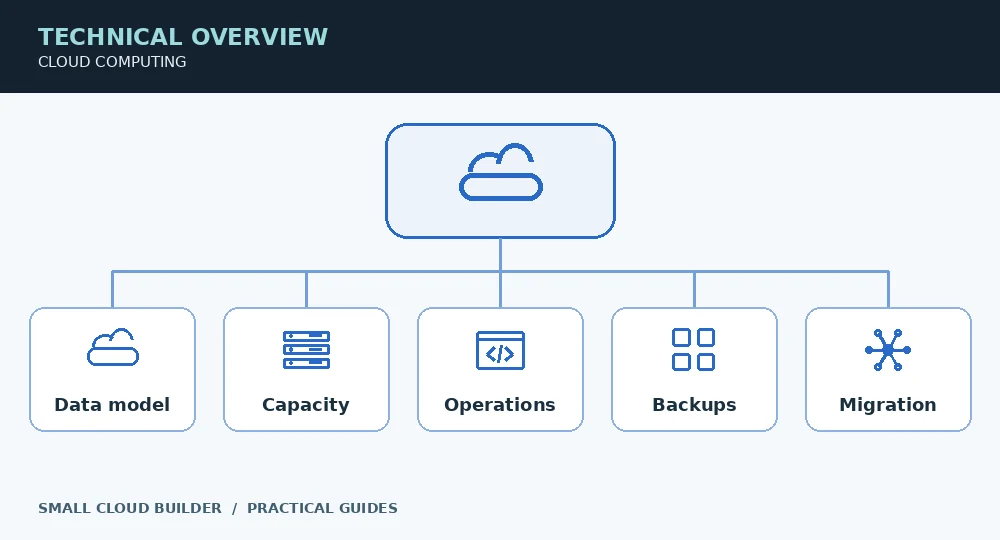
Data model
Choose relational tables for transactions and integrity where appropriate; document stores suit different query and update patterns.
For data model, a useful comparison is one that a colleague can independently reproduce. Test a representative transaction that updates two related appointment records. Describe the relevant starting conditions and save the result using consistent terminology. Avoid comparing a first-time setup in one system with an already optimized setup in another unless the difference is explicitly part of the evaluation. Make note of the effort required to reach a usable state as well as the eventual result. In a business environment, the time required to repeat a configuration, recover access or diagnose a problem is a real constraint, even when it is not reflected in a product specification.
The cost of an incorrect assumption increases as more people or records depend on it. Resolve uncertainty while the configuration is still small. A precise limitation is more useful than a general assurance that the system should probably work in a larger environment.
Capacity
Measure indexing, query latency, concurrent connections and disk usage under realistic access patterns.
A demonstration can be misleading when it uses a perfectly prepared environment. The useful question is what happens during routine work. Inspect the slowest common query and its behavior with representative data volumes. Use an ordinary sample, with enough variation to reveal common problems but without requiring live customer records. Where behavior differs between a new environment and the existing one, establish which difference matters to the business before making a choice. Keep a record of errors and unexpected constraints as well as successes. An inconclusive test is a reason to refine the experiment, not a reason to assume that capacity has been solved.
There is no need for a large spreadsheet if a short set of observations is sufficient. The purpose is to make the decision traceable, distinguish known limitations from speculation and preserve enough information to investigate a reported problem later.
Operations
Managed updates and replication reduce tasks but do not remove schema design or restoration planning.
If a booking request creates an appointment and marks a timeslot unavailable, those outcomes must remain consistent even when a connection fails midway through the operation. A managed relational database can support transactions, but the application still needs to define the correct boundaries and handle errors without creating duplicate bookings.
Separate the initial selection from the evidence that supports it. Measure connection use during a peak interval. The test should be small enough that a mistake is reversible and sufficiently representative that the result can guide a decision. Record what direct observation establishes and what remains an assumption. For example, one successful run says little about unusual inputs or a much higher level of demand. Use the first observation to decide what another test ought to cover. As work moves from evaluation into routine operation, revisit the assumptions about operations rather than leaving them frozen in the original proposal.
It is worth writing down any restriction discovered during the check, including one that does not affect the present workload. A future maintainer may not have the same assumptions about data size, supported devices or how often the procedure needs to run.
For another perspective on the same infrastructure or workflow decision, see Cloud Disaster Recovery for Small Teams. Compare the requirements it identifies with the constraints in your own environment.
Backups
Confirm retention, point-in-time recovery, export format and restoration time to a separate environment.
A less obvious part of backups is the boundary between an individual task and the system around it. Restore a sample database from a recent recovery point without replacing production. Check the environment before and after the exercise, making sure unrelated records or settings have not changed. Record any dependencies required for success and distinguish permanent requirements from one-time setup work. A process that depends on a temporary test account, a particular device or an undocumented configuration may need additional work before it is ready for normal use. Leave room in the plan for that discovery rather than committing to a launch date on the strength of a first successful attempt.
Avoid building the rest of the project around an undocumented assumption. The useful output here is a small record of the actual behavior and any constraints that may affect the next decision. If another person cannot interpret that record, add the missing context while it is still easy to recover.
Migration
Rehearse schema changes and cutover with a test copy; preserve a verified rollback path.
The distinction becomes easier to see with an explicit acceptance test. Run the same schema migration on a test copy and confirm the application still works. Decide in advance which outcome would be a success. A measurement that looks impressive on its own may be irrelevant if the original task remains difficult or unreliable. Track failures alongside the successful result; a capability that works only when a particular person is present may be less useful than a slightly slower process anyone on the team can follow. The final choice should reflect the actual working requirements around migration, including what the team can reasonably support after the initial installation.
Before extending the setup, identify the part that is hardest to reverse. A limited pilot lets the team address problems in that part without affecting unrelated work. Keep the dependable existing process available until the replacement has passed the checks that matter.
Putting the findings to work
Separate shared infrastructure costs from the demand attributable to one application. A resource that remains allocated between traffic peaks has different cost behavior from a usage-metered execution service. To compare the two, capture operating hours, data transfer, requests and retention, including resources maintained for recovery or testing. This avoids making a decision based only on the cheapest visible unit price.
For a short review before making the decision, return to the concrete checks from the guide:
- Test a representative transaction that updates two related appointment records.
- Inspect the slowest common query and its behavior with representative data volumes.
- Measure connection use during a peak interval.
- Restore a sample database from a recent recovery point without replacing production.
- Run the same schema migration on a test copy and confirm the application still works.
The most suitable managed engine is one the team understands and can recover under pressure. Keep the key observations available to the people responsible for the system, with enough detail to revisit the decision when the workload, tools or business requirements change.
Related guide: Cloud Migration Checklist for Existing Applications. Move applications with an inventory, test environment, cutover and rollback sequence.
Related guide: Choosing Cloud Office Software. Compare document collaboration, storage access and administration for everyday work.