Cloud Disaster Recovery for Small Teams
Turn recovery objectives, backups and rehearsals into a workable continuity plan.
A subscription service cannot afford to lose more than an hour of orders or remain offline all day. A small team benefits more from a rehearsed recovery path than an elaborate architecture nobody has tested. This is a useful situation in which to make the technical requirements explicit before changing tools, because the choices affect day-to-day work as well as the initial setup.
Separate shared infrastructure costs from the demand attributable to one application. A resource that remains allocated between traffic peaks has different cost behavior from a usage-metered execution service. To compare the two, capture operating hours, data transfer, requests and retention, including resources maintained for recovery or testing. This avoids making a decision based only on the cheapest visible unit price.
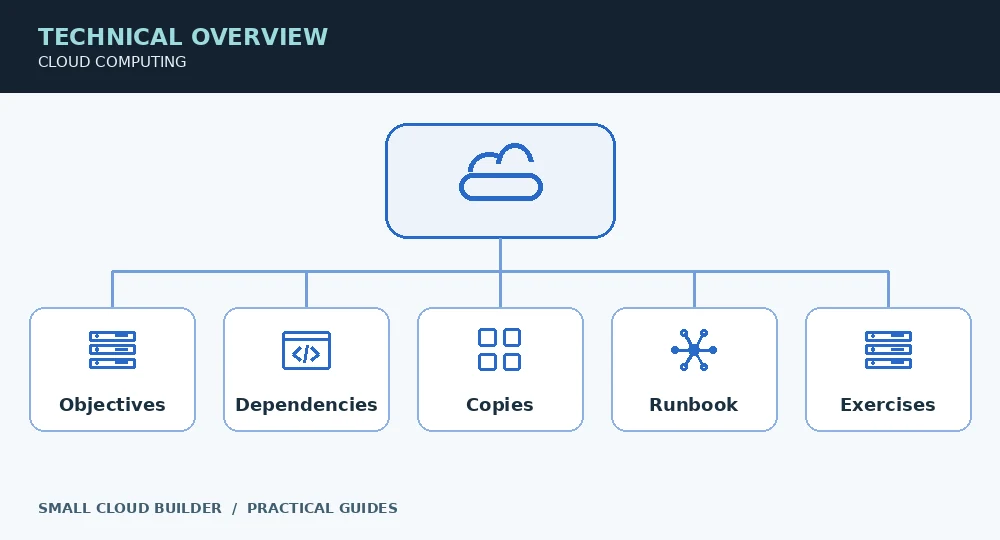
Objectives
State RPO as acceptable data loss and RTO as acceptable recovery time. Set different targets for different workloads.
Separate the initial selection from the evidence that supports it. Calculate the amount of order data generated during the agreed one-hour window. The test should be small enough that a mistake is reversible and sufficiently representative that the result can guide a decision. Record what direct observation establishes and what remains an assumption. For example, one successful run says little about unusual inputs or a much higher level of demand. Use the first observation to decide what another test ought to cover. As work moves from evaluation into routine operation, revisit the assumptions about objectives rather than leaving them frozen in the original proposal.
Treat a successful result as evidence for the particular situation that was tested. Changes to the environment can alter that behavior. A lightweight regression check after important changes makes it easier to identify when a previously dependable assumption no longer holds.
Dependencies
Map DNS, identities, databases, application binaries and credentials. A recovered server is useless if authentication is missing.
An implementation plan should state who owns dependencies once the work is complete. List dependencies not included in database snapshots, including account configuration. Ask the person responsible for ongoing administration to take part in verifying the result, rather than handing them an unfamiliar setup at the end. They need to know where to find the relevant configuration, what a normal result looks like and what to do if it changes unexpectedly. Where two roles share responsibility, document the handoff. In a small organization, clear ownership and a repeatable check often prevent problems that an additional piece of software would merely make more difficult to investigate.
When comparing choices, include the ordinary maintenance procedure as a requirement. If the team can only demonstrate a capability with extensive assistance, plan for that dependency rather than assuming the same results will be available without it.
Copies
Keep protected backups separated from production credentials and verify restoration into a clean environment.
A written requirement is most valuable when it can be tested without guessing what the author meant. Recover a test copy using access that does not depend on the failed environment. Establish a meaningful threshold for the result, whether that is correctness, usable response time, preservation of records or successful access by the intended person. Do not silently revise the threshold after seeing a disappointing outcome; instead, decide whether the business requirement itself has changed. Even a modest record of test results helps a small team make later decisions about copies without relying on a recollection of which option looked most convincing during the initial evaluation.
The people who carry out routine work may notice different problems from the person who set up the system. Include their observations, particularly repeated manual steps or confusing states. These details can dominate the long-term effort even when the underlying technology performs well.
For another perspective on the same infrastructure or workflow decision, see How Load Balancers Distribute Application Traffic. Compare the requirements it identifies with the constraints in your own environment.
Runbook
Record owners, access paths, decision points and service validation; make instructions available during an outage.
If orders arrive at 40 per hour and a backup is taken every four hours, a failure immediately before the next copy could leave close to 160 orders outside the backup. Replication changes availability characteristics, but corruption or accidental changes may also replicate. A point-in-time recovery mechanism addresses a different risk.
For runbook, a useful comparison is one that a colleague can independently reproduce. Time each stage of the recovery runbook and identify the longest delay. Describe the relevant starting conditions and save the result using consistent terminology. Avoid comparing a first-time setup in one system with an already optimized setup in another unless the difference is explicitly part of the evaluation. Make note of the effort required to reach a usable state as well as the eventual result. In a business environment, the time required to repeat a configuration, recover access or diagnose a problem is a real constraint, even when it is not reflected in a product specification.
There is no need for a large spreadsheet if a short set of observations is sufficient. The purpose is to make the decision traceable, distinguish known limitations from speculation and preserve enough information to investigate a reported problem later.
Exercises
Restore representative data periodically and record actual recovery time rather than relying on vendor availability statistics.
The distinction becomes easier to see with an explicit acceptance test. Document the point at which the restored service can accept new transactions safely. Decide in advance which outcome would be a success. A measurement that looks impressive on its own may be irrelevant if the original task remains difficult or unreliable. Track failures alongside the successful result; a capability that works only when a particular person is present may be less useful than a slightly slower process anyone on the team can follow. The final choice should reflect the actual working requirements around exercises, including what the team can reasonably support after the initial installation.
The cost of an incorrect assumption increases as more people or records depend on it. Resolve uncertainty while the configuration is still small. A precise limitation is more useful than a general assurance that the system should probably work in a larger environment.
Putting the findings to work
Cloud infrastructure splits responsibility across multiple control layers. Physical facilities, network services, guest systems, managed runtimes, application configuration and data can all have different operators. A hosting invoice may list a resource that looks self-contained even though it depends on identity services, DNS, monitoring and recovery storage. Draw the few boundaries that matter for this workload first. In the event of a problem, they are often more useful than a diagram showing every available cloud service.
For a short review before making the decision, return to the concrete checks from the guide:
- Calculate the amount of order data generated during the agreed one-hour window.
- List dependencies not included in database snapshots, including account configuration.
- Recover a test copy using access that does not depend on the failed environment.
- Time each stage of the recovery runbook and identify the longest delay.
- Document the point at which the restored service can accept new transactions safely.
A small team benefits more from a rehearsed recovery path than an elaborate architecture nobody has tested. Keep the key observations available to the people responsible for the system, with enough detail to revisit the decision when the workload, tools or business requirements change.
Related guide: Cloud Monitoring: Metrics, Logs and Alerts. Build observability that identifies failures without drowning a small team in notifications.
Related guide: Website Backups: What to Save and How to Restore. Create backups that cover content, database records, settings and recovery requirements.