Cloud Monitoring: Metrics, Logs and Alerts
Build observability that identifies failures without drowning a small team in notifications.
An online course platform sometimes becomes slow during evening enrollment peaks. Monitoring is useful when a person can decide what to do from an alert, not simply see more graphs. Rather than starting with a long feature list, begin with the task itself. This makes it possible to compare alternatives against a real requirement and identify responsibilities before committing to a design.
Separate shared infrastructure costs from the demand attributable to one application. A resource that remains allocated between traffic peaks has different cost behavior from a usage-metered execution service. To compare the two, capture operating hours, data transfer, requests and retention, including resources maintained for recovery or testing. This avoids making a decision based only on the cheapest visible unit price.
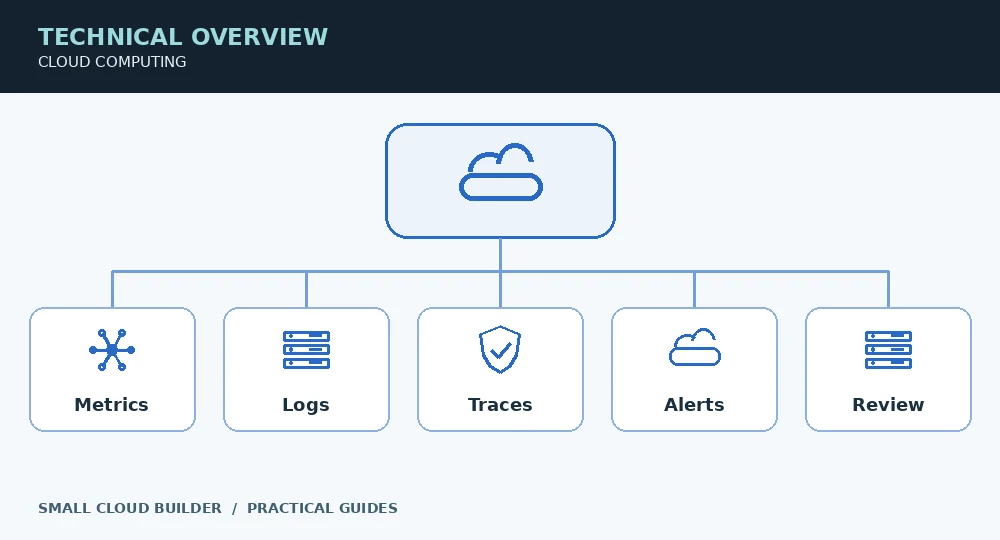
Metrics
Monitor request duration, error rates, traffic and resource saturation; choose percentiles rather than averages alone.
In the planning stage, avoid treating metrics as a feature checkbox. Compare the median and the slower tail of request times during a representative lesson launch. This gives the team a real starting point for comparison. Note how much setup and administrative effort the task requires, and whether the result can be repeated without relying on special access unavailable to ordinary users. If the proposed system changes the way a person completes their work, try the new process from that role's perspective as well. The aim is to establish what is possible with the configuration you will actually operate, rather than what is possible in an ideal demonstration.
Before extending the setup, identify the part that is hardest to reverse. A limited pilot lets the team address problems in that part without affecting unrelated work. Keep the dependable existing process available until the replacement has passed the checks that matter.
Logs
Use structured events with request identifiers and limit sensitive content. Define retention and search costs.
Separate the initial selection from the evidence that supports it. Inspect messages carrying request identifiers without including confidential form content. The test should be small enough that a mistake is reversible and sufficiently representative that the result can guide a decision. Record what direct observation establishes and what remains an assumption. For example, one successful run says little about unusual inputs or a much higher level of demand. Use the first observation to decide what another test ought to cover. As work moves from evaluation into routine operation, revisit the assumptions about logs rather than leaving them frozen in the original proposal.
The cost of an incorrect assumption increases as more people or records depend on it. Resolve uncertainty while the configuration is still small. A precise limitation is more useful than a general assurance that the system should probably work in a larger environment.
Traces
Follow representative requests across services to isolate bottlenecks and long dependency calls.
Separate the initial selection from the evidence that supports it. Follow a single slow request from frontend through its database call. The test should be small enough that a mistake is reversible and sufficiently representative that the result can guide a decision. Record what direct observation establishes and what remains an assumption. For example, one successful run says little about unusual inputs or a much higher level of demand. Use the first observation to decide what another test ought to cover. As work moves from evaluation into routine operation, revisit the assumptions about traces rather than leaving them frozen in the original proposal.
Avoid building the rest of the project around an undocumented assumption. The useful output here is a small record of the actual behavior and any constraints that may affect the next decision. If another person cannot interpret that record, add the missing context while it is still easy to recover.
For another perspective on the same infrastructure or workflow decision, see Cloud Computing for Small Businesses: Where to Start. Compare the requirements it identifies with the constraints in your own environment.
Alerts
Alert on user-visible symptoms or fast-moving resource limits, with an owner and action.
Average request time can conceal the experience of the slowest users. If 95 of 100 requests complete in 120 milliseconds and five take several seconds, the apparent average provides little guidance about the delayed operations. Compare high percentiles, traffic and errors, then investigate a representative slow trace.
A written requirement is most valuable when it can be tested without guessing what the author meant. Trigger a benign threshold in a test environment to verify the notification path. Establish a meaningful threshold for the result, whether that is correctness, usable response time, preservation of records or successful access by the intended person. Do not silently revise the threshold after seeing a disappointing outcome; instead, decide whether the business requirement itself has changed. Even a modest record of test results helps a small team make later decisions about alerts without relying on a recollection of which option looked most convincing during the initial evaluation.
Treat a successful result as evidence for the particular situation that was tested. Changes to the environment can alter that behavior. A lightweight regression check after important changes makes it easier to identify when a previously dependable assumption no longer holds.
Review
Use incident records to tune thresholds, eliminate low-value alerts and identify recurring constraints.
A less obvious part of review is the boundary between an individual task and the system around it. Review one week's alerts against actual customer impact and remove noisy duplicates. Check the environment before and after the exercise, making sure unrelated records or settings have not changed. Record any dependencies required for success and distinguish permanent requirements from one-time setup work. A process that depends on a temporary test account, a particular device or an undocumented configuration may need additional work before it is ready for normal use. Leave room in the plan for that discovery rather than committing to a launch date on the strength of a first successful attempt.
There is no need for a large spreadsheet if a short set of observations is sufficient. The purpose is to make the decision traceable, distinguish known limitations from speculation and preserve enough information to investigate a reported problem later.
Putting the findings to work
Cloud infrastructure splits responsibility across multiple control layers. Physical facilities, network services, guest systems, managed runtimes, application configuration and data can all have different operators. A hosting invoice may list a resource that looks self-contained even though it depends on identity services, DNS, monitoring and recovery storage. Draw the few boundaries that matter for this workload first. In the event of a problem, they are often more useful than a diagram showing every available cloud service.
For a short review before making the decision, return to the concrete checks from the guide:
- Compare the median and the slower tail of request times during a representative lesson launch.
- Inspect messages carrying request identifiers without including confidential form content.
- Follow a single slow request from frontend through its database call.
- Trigger a benign threshold in a test environment to verify the notification path.
- Review one week's alerts against actual customer impact and remove noisy duplicates.
Monitoring is useful when a person can decide what to do from an alert, not simply see more graphs. Keep the key observations available to the people responsible for the system, with enough detail to revisit the decision when the workload, tools or business requirements change.
Related guide: Understanding IaaS, PaaS and SaaS. Compare the layers you operate, delegate and pay for in common cloud delivery models.
Related guide: How CDNs Improve Website Performance. Use edge delivery, cache policies and origin protection without serving stale private content.