How Load Balancers Distribute Application Traffic
Understand health checks, traffic distribution, TLS and backend failure handling.
A storefront runs two application instances behind a single public endpoint. A load balancer reduces dependency on individual instances but must itself fit the availability and capacity plan. The details matter more than product labels. The challenge is to understand which parts of the system the business depends on, where the limits are and how to check the proposed approach under realistic conditions.
Cloud infrastructure splits responsibility across multiple control layers. Physical facilities, network services, guest systems, managed runtimes, application configuration and data can all have different operators. A hosting invoice may list a resource that looks self-contained even though it depends on identity services, DNS, monitoring and recovery storage. Draw the few boundaries that matter for this workload first. In the event of a problem, they are often more useful than a diagram showing every available cloud service.
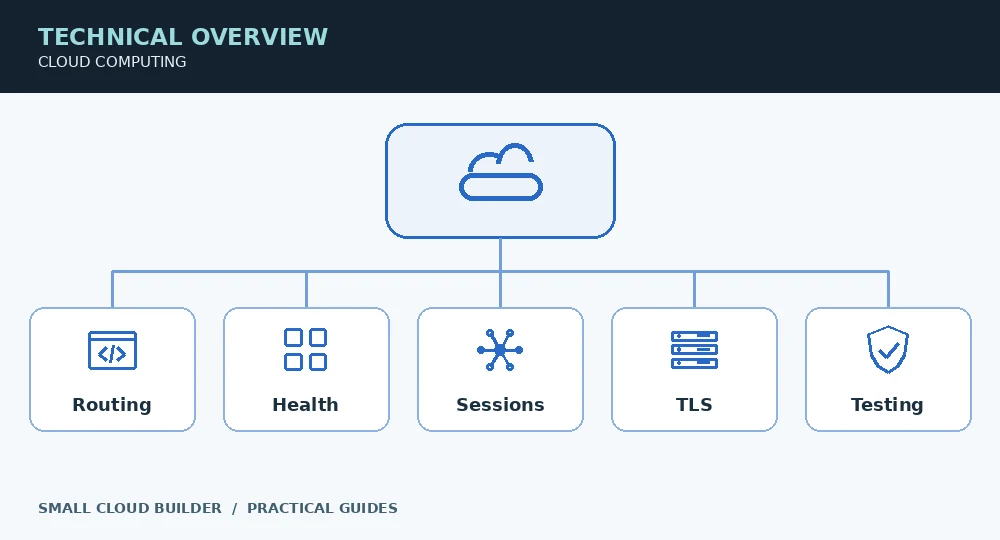
Routing
Layer 4 forwarding operates on transport properties; layer 7 can select destinations using HTTP request information.
The distinction becomes easier to see with an explicit acceptance test. Compare 100 sample requests across two equivalent backends. Decide in advance which outcome would be a success. A measurement that looks impressive on its own may be irrelevant if the original task remains difficult or unreliable. Track failures alongside the successful result; a capability that works only when a particular person is present may be less useful than a slightly slower process anyone on the team can follow. The final choice should reflect the actual working requirements around routing, including what the team can reasonably support after the initial installation.
The cost of an incorrect assumption increases as more people or records depend on it. Resolve uncertainty while the configuration is still small. A precise limitation is more useful than a general assurance that the system should probably work in a larger environment.
Health
Choose checks that reflect readiness without overloading dependencies. Distinguish startup delay from permanent failure.
Two instances do not imply twice the reliable traffic capacity. If either can sustain 60 requests per second in the measured configuration, an application expecting 100 requests per second may overload the survivor after one instance fails. Redundant capacity calculations must consider the remaining service during planned and unplanned interruptions.
In the planning stage, avoid treating health as a feature checkbox. Stop a disposable test instance and observe the balancing service's health decision. This gives the team a real starting point for comparison. Note how much setup and administrative effort the task requires, and whether the result can be repeated without relying on special access unavailable to ordinary users. If the proposed system changes the way a person completes their work, try the new process from that role's perspective as well. The aim is to establish what is possible with the configuration you will actually operate, rather than what is possible in an ideal demonstration.
Before extending the setup, identify the part that is hardest to reverse. A limited pilot lets the team address problems in that part without affecting unrelated work. Keep the dependable existing process available until the replacement has passed the checks that matter.
Sessions
Prefer stateless application instances or a shared session store rather than assuming sticky sessions solve failover.
Start with what is already observable. Verify session continuity after a representative backend restart. Write down the result alongside the original expectation. A useful comparison keeps the workload and the surrounding conditions stable; differences in sample size, connection quality or a change made elsewhere in the system can otherwise distort the conclusion. The value of this check is not that it proves the entire design. It exposes whether the assumption about sessions holds under a recognizable working condition, and whether somebody has enough information to repeat the observation later without reconstructing the whole experiment from memory.
It is worth writing down any restriction discovered during the check, including one that does not affect the present workload. A future maintainer may not have the same assumptions about data size, supported devices or how often the procedure needs to run.
For another perspective on the same infrastructure or workflow decision, see Cloud Migration Checklist for Existing Applications. Compare the requirements it identifies with the constraints in your own environment.
TLS
Decide where encryption terminates and how certificates renew. Secure connections to backends according to risk.
A demonstration can be misleading when it uses a perfectly prepared environment. The useful question is what happens during routine work. Check where the public certificate is presented and how backends authenticate. Use an ordinary sample, with enough variation to reveal common problems but without requiring live customer records. Where behavior differs between a new environment and the existing one, establish which difference matters to the business before making a choice. Keep a record of errors and unexpected constraints as well as successes. An inconclusive test is a reason to refine the experiment, not a reason to assume that tls has been solved.
The people who carry out routine work may notice different problems from the person who set up the system. Include their observations, particularly repeated manual steps or confusing states. These details can dominate the long-term effort even when the underlying technology performs well.
Testing
Observe errors, response latency and backend distribution during a controlled maintenance exercise.
A written requirement is most valuable when it can be tested without guessing what the author meant. Record error and latency changes during controlled removal of a single backend. Establish a meaningful threshold for the result, whether that is correctness, usable response time, preservation of records or successful access by the intended person. Do not silently revise the threshold after seeing a disappointing outcome; instead, decide whether the business requirement itself has changed. Even a modest record of test results helps a small team make later decisions about testing without relying on a recollection of which option looked most convincing during the initial evaluation.
If the exercise requires temporary privileges or a special configuration, separate those from what the finished system actually needs. Remove temporary access when it is no longer required and document the configuration that the team expects to keep.
Putting the findings to work
Capacity and availability are related but not identical. A system can have abundant capacity and still be unavailable if an essential dependency fails. A redundant design can also perform badly if surviving components cannot handle the traffic. Treat an observed performance limit and a failure-recovery target as separate requirements and test them with appropriate workloads.
For a short review before making the decision, return to the concrete checks from the guide:
- Compare 100 sample requests across two equivalent backends.
- Stop a disposable test instance and observe the balancing service's health decision.
- Verify session continuity after a representative backend restart.
- Check where the public certificate is presented and how backends authenticate.
- Record error and latency changes during controlled removal of a single backend.
A load balancer reduces dependency on individual instances but must itself fit the availability and capacity plan. Keep the key observations available to the people responsible for the system, with enough detail to revisit the decision when the workload, tools or business requirements change.
Related guide: Cloud Computing for Small Businesses: Where to Start. Choose the right first cloud services without inheriting a complicated infrastructure bill.
Related guide: HTTPS and TLS Certificates for Website Owners. Understand certificate trust, renewal and safe HTTPS transitions.