HTTPS and TLS Certificates for Website Owners
Understand certificate trust, renewal and safe HTTPS transitions.

A company is relaunching a site that previously used plain HTTP on some pages. HTTPS protects network transport; it does not replace authentication, secure application code or trustworthy content. This is a useful situation in which to make the technical requirements explicit before changing tools, because the choices affect day-to-day work as well as the initial setup.
Public pages are accessed by people, browsers, search systems and links from other websites. Stable addresses matter because those consumers do not all update immediately when a new version is deployed. Keep internal links consistent, preserve appropriate destinations for changed addresses and verify real response codes. A page that looks correct in one browser does not demonstrate that the old and new public paths work correctly.
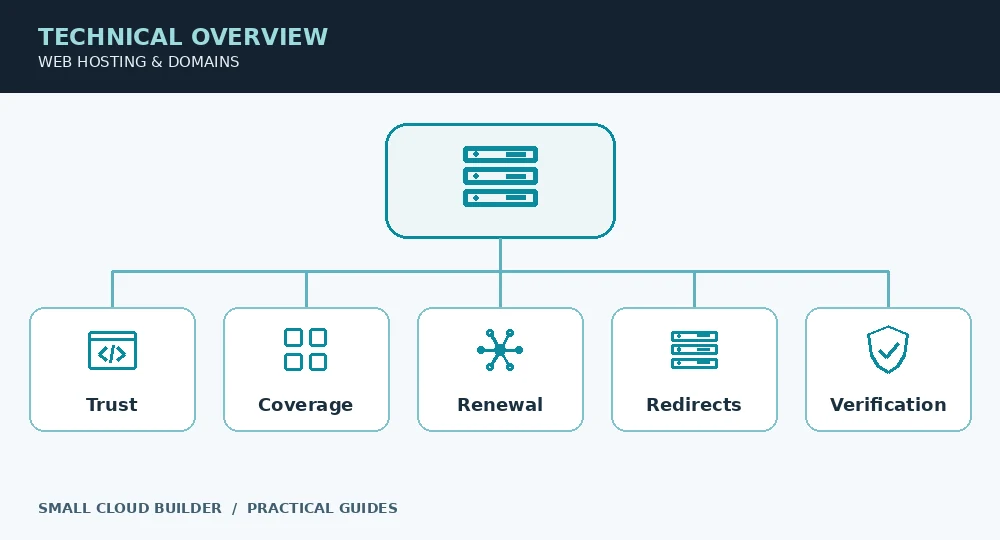
Trust
Certificates bind hostnames to public keys through a trusted certificate chain. Encryption depends on correct protocol configuration.
A less obvious part of trust is the boundary between an individual task and the system around it. Verify the selected hostname and its alternative resolve to a certificate with appropriate coverage. Check the environment before and after the exercise, making sure unrelated records or settings have not changed. Record any dependencies required for success and distinguish permanent requirements from one-time setup work. A process that depends on a temporary test account, a particular device or an undocumented configuration may need additional work before it is ready for normal use. Leave room in the plan for that discovery rather than committing to a launch date on the strength of a first successful attempt.
It is worth writing down any restriction discovered during the check, including one that does not affect the present workload. A future maintainer may not have the same assumptions about data size, supported devices or how often the procedure needs to run.
Coverage
Include all hostnames that serve HTTPS, including the chosen www or non-www version.
Separate the initial selection from the evidence that supports it. Inspect a representative HTML document for HTTP image and script references. The test should be small enough that a mistake is reversible and sufficiently representative that the result can guide a decision. Record what direct observation establishes and what remains an assumption. For example, one successful run says little about unusual inputs or a much higher level of demand. Use the first observation to decide what another test ought to cover. As work moves from evaluation into routine operation, revisit the assumptions about coverage rather than leaving them frozen in the original proposal.
Record a failure before changing several settings at once. A clear observation made under known conditions makes troubleshooting much easier. With multiple simultaneous changes, it may become difficult to tell which action corrected the issue or whether it merely hid the symptom.
Renewal
Automate certificate renewal and monitor expiry; renewal failure can interrupt otherwise healthy sites.
When HTTPS is enabled for example.com but not for www.example.com, a browser visiting the alternative HTTPS hostname may reject the certificate before it can receive a redirect. Provision valid coverage for relevant hostnames first. A redirect changes the requested destination; it cannot repair the preceding TLS handshake.
There is a straightforward way to turn renewal into a decision instead of an argument about features. Test the process that renews certificates before the deadline. Keep the result in a short working note: the starting conditions, what was changed, what actually happened and the outcome that would be acceptable in production. If the result is different from the expected behavior, isolate the cause before adding another component. This is particularly important for a small team, where the person implementing a solution is often also the person who will have to maintain it and explain a failure to colleagues.
The cost of an incorrect assumption increases as more people or records depend on it. Resolve uncertainty while the configuration is still small. A precise limitation is more useful than a general assurance that the system should probably work in a larger environment.
For another perspective on the same infrastructure or workflow decision, see How to Move a Website Without Losing URLs. Compare the requirements it identifies with the constraints in your own environment.
Redirects
Redirect HTTP to the canonical HTTPS URL, update internal links and fix mixed-content assets.
For redirects, a useful comparison is one that a colleague can independently reproduce. Check that secure links point directly to the canonical HTTPS hostname. Describe the relevant starting conditions and save the result using consistent terminology. Avoid comparing a first-time setup in one system with an already optimized setup in another unless the difference is explicitly part of the evaluation. Make note of the effort required to reach a usable state as well as the eventual result. In a business environment, the time required to repeat a configuration, recover access or diagnose a problem is a real constraint, even when it is not reflected in a product specification.
There is no need for a large spreadsheet if a short set of observations is sufficient. The purpose is to make the decision traceable, distinguish known limitations from speculation and preserve enough information to investigate a reported problem later.
Verification
Test certificate validity, chain presentation, expected hostnames and browser behavior after changing hosting.
A written requirement is most valuable when it can be tested without guessing what the author meant. Confirm important cookies and authentication flows still behave as intended. Establish a meaningful threshold for the result, whether that is correctness, usable response time, preservation of records or successful access by the intended person. Do not silently revise the threshold after seeing a disappointing outcome; instead, decide whether the business requirement itself has changed. Even a modest record of test results helps a small team make later decisions about verification without relying on a recollection of which option looked most convincing during the initial evaluation.
The people who carry out routine work may notice different problems from the person who set up the system. Include their observations, particularly repeated manual steps or confusing states. These details can dominate the long-term effort even when the underlying technology performs well.
Putting the findings to work
Website files and application state are different. Static files can usually be deployed together and rolled back as one release, whereas a live database or order history may keep changing after a deployment. A rollback plan must take those differences into account. Do not assume restoring an older application version can also restore a newer database state safely.
For a short review before making the decision, return to the concrete checks from the guide:
- Verify the selected hostname and its alternative resolve to a certificate with appropriate coverage.
- Inspect a representative HTML document for HTTP image and script references.
- Test the process that renews certificates before the deadline.
- Check that secure links point directly to the canonical HTTPS hostname.
- Confirm important cookies and authentication flows still behave as intended.
HTTPS protects network transport; it does not replace authentication, secure application code or trustworthy content. Keep the key observations available to the people responsible for the system, with enough detail to revisit the decision when the workload, tools or business requirements change.
Related guide: Choosing a Domain Name for a Business Website. Evaluate readability, ownership, renewal and practical brand use.
Related guide: How Load Balancers Distribute Application Traffic. Understand health checks, traffic distribution, TLS and backend failure handling.