Cybersecurity Basics for Small Businesses
Establish practical foundations for account, device and information protection.
A small company has cloud subscriptions, employee laptops and a public website but no dedicated security team. Start with proven routine controls that reduce predictable risks before investing in complex tools. The following guide treats the problem as a working decision: what needs to happen, what the technology actually provides, and which observations can support a choice.
Routine maintenance provides a foundation for more complicated security work. Keep software supported, remove unnecessary access, preserve appropriate logs and test recovery procedures with authorized tools and harmless sample data. Record responsibility for following up on notices and problems. Do not assume that a product will investigate every unusual event or make decisions on behalf of the organization.
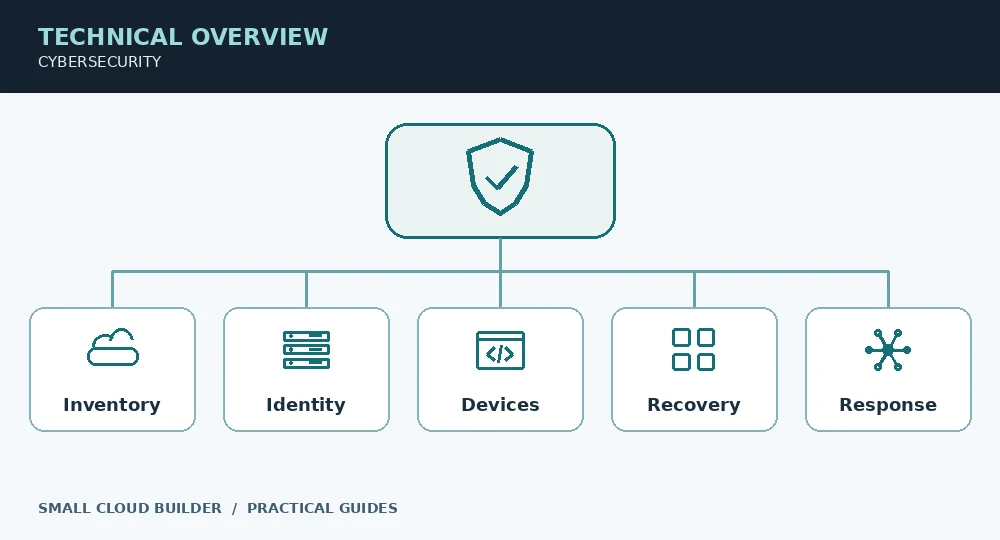
Inventory
List business accounts, devices, applications and important records, naming an owner for each.
There is a straightforward way to turn inventory into a decision instead of an argument about features. List the accounts that can reset other business accounts. Keep the result in a short working note: the starting conditions, what was changed, what actually happened and the outcome that would be acceptable in production. If the result is different from the expected behavior, isolate the cause before adding another component. This is particularly important for a small team, where the person implementing a solution is often also the person who will have to maintain it and explain a failure to colleagues.
Record a failure before changing several settings at once. A clear observation made under known conditions makes troubleshooting much easier. With multiple simultaneous changes, it may become difficult to tell which action corrected the issue or whether it merely hid the symptom.
Identity
Use individual accounts, strong authentication and least-privilege roles, with a recoverable administrator arrangement.
The concern is not whether all possible features are enabled. It is whether a specific need is satisfied consistently. Check supported update versions on representative devices. If possible, repeat it after a normal restart, reconnection or change of user session appropriate to the system. Notice which behavior is preserved automatically and which must be configured again. This is a useful way to establish how identity will affect maintenance, particularly when the same setup has to be reproduced on another device or in another environment. A useful test produces enough detail to explain the result and identify the next action.
The people who carry out routine work may notice different problems from the person who set up the system. Include their observations, particularly repeated manual steps or confusing states. These details can dominate the long-term effort even when the underlying technology performs well.
Devices
Keep supported software up to date, enable appropriate device protection and remove unused applications.
An email administrator can often reset access to other subscriptions, so the email account is effectively part of the organization's recovery infrastructure. Protect it accordingly and document alternative contact methods. An inventory should distinguish ordinary user accounts from identities able to change permissions or recovery settings.
In the planning stage, avoid treating devices as a feature checkbox. Review whether a routine user has unnecessary administrative permissions. This gives the team a real starting point for comparison. Note how much setup and administrative effort the task requires, and whether the result can be repeated without relying on special access unavailable to ordinary users. If the proposed system changes the way a person completes their work, try the new process from that role's perspective as well. The aim is to establish what is possible with the configuration you will actually operate, rather than what is possible in an ideal demonstration.
There is no need for a large spreadsheet if a short set of observations is sufficient. The purpose is to make the decision traceable, distinguish known limitations from speculation and preserve enough information to investigate a reported problem later.
For another perspective on the same infrastructure or workflow decision, see Multi-Factor Authentication and Passkeys Explained. Compare the requirements it identifies with the constraints in your own environment.
Recovery
Keep separated, tested backups and document what to do if ordinary accounts become unavailable.
Separate the initial selection from the evidence that supports it. Restore a sample document from an independent backup. The test should be small enough that a mistake is reversible and sufficiently representative that the result can guide a decision. Record what direct observation establishes and what remains an assumption. For example, one successful run says little about unusual inputs or a much higher level of demand. Use the first observation to decide what another test ought to cover. As work moves from evaluation into routine operation, revisit the assumptions about recovery rather than leaving them frozen in the original proposal.
If the exercise requires temporary privileges or a special configuration, separate those from what the finished system actually needs. Remove temporary access when it is no longer required and document the configuration that the team expects to keep.
Response
Define who handles suspicious messages, missing devices and accidental disclosures; review events calmly.
A written requirement is most valuable when it can be tested without guessing what the author meant. Walk through a lost-device or suspicious-message scenario with the responsible person. Establish a meaningful threshold for the result, whether that is correctness, usable response time, preservation of records or successful access by the intended person. Do not silently revise the threshold after seeing a disappointing outcome; instead, decide whether the business requirement itself has changed. Even a modest record of test results helps a small team make later decisions about response without relying on a recollection of which option looked most convincing during the initial evaluation.
Before extending the setup, identify the part that is hardest to reverse. A limited pilot lets the team address problems in that part without affecting unrelated work. Keep the dependable existing process available until the replacement has passed the checks that matter.
A security control addresses a particular risk, not every possible problem. Account authentication limits some unauthorized access; restricted permissions limit what an authenticated identity can do; independent recovery copies help after damaging changes. These controls complement one another. A small organization benefits from identifying sensitive systems and assigning ownership before introducing additional complexity.
Putting the findings to work
Review controls from both the ordinary user's and the administrator's perspectives. A recovery path that is impossible to use in a real incident may encourage unsafe workarounds. Excessive administrator permissions can also turn a routine mistake into a serious problem. The aim is a practical process that enables legitimate work while keeping sensitive actions subject to appropriate control.
For a short review before making the decision, return to the concrete checks from the guide:
- List the accounts that can reset other business accounts.
- Check supported update versions on representative devices.
- Review whether a routine user has unnecessary administrative permissions.
- Restore a sample document from an independent backup.
- Walk through a lost-device or suspicious-message scenario with the responsible person.
Start with proven routine controls that reduce predictable risks before investing in complex tools. Keep the key observations available to the people responsible for the system, with enough detail to revisit the decision when the workload, tools or business requirements change.
Related guide: Recognizing and Reporting Phishing Attempts. Help staff respond consistently to suspicious messages and unexpected requests.
Related guide: How Cloud Billing Works: Estimate and Control Costs. Read usage-based invoices and establish a practical monthly forecast.