Building an Internal Knowledge Base with SaaS
Create a maintainable source of operating instructions and decisions.

A remote company has answers scattered through personal notes, email threads and chat messages. A knowledge base reduces repetitive questions when staff can trust the answers and update them. The following guide treats the problem as a working decision: what needs to happen, what the technology actually provides, and which observations can support a choice.
The licensing bill is only one element of operational cost. People spend time mapping incoming records, maintaining templates, resolving synchronization issues and training colleagues. Those recurring tasks should be visible during evaluation. A modest subscription that eliminates a significant manual step can be better value than a feature-rich alternative that requires additional administration.
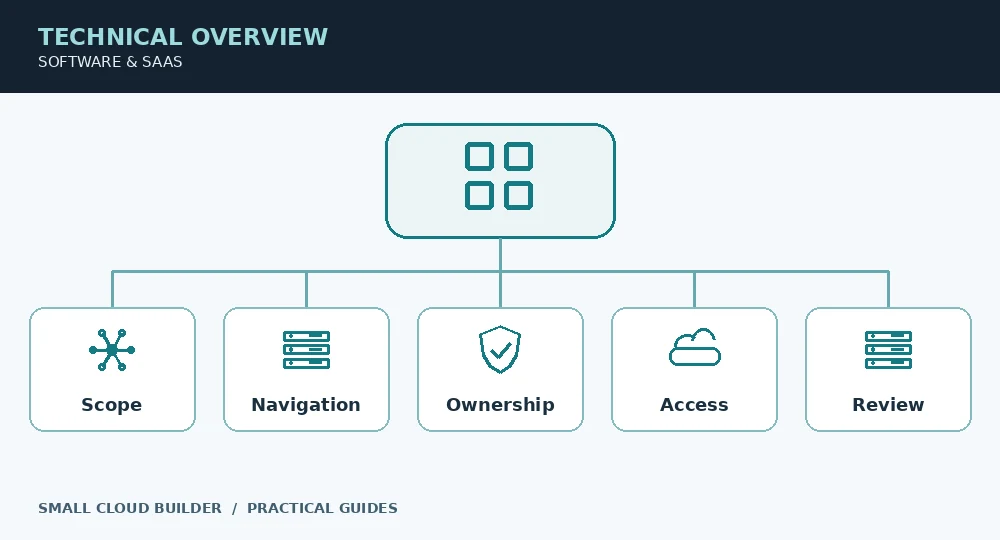
Scope
Separate stable procedures, reference information and temporary work notes.
The distinction becomes easier to see with an explicit acceptance test. Collect recurring onboarding questions and identify missing procedural documents. Decide in advance which outcome would be a success. A measurement that looks impressive on its own may be irrelevant if the original task remains difficult or unreliable. Track failures alongside the successful result; a capability that works only when a particular person is present may be less useful than a slightly slower process anyone on the team can follow. The final choice should reflect the actual working requirements around scope, including what the team can reasonably support after the initial installation.
Record a failure before changing several settings at once. A clear observation made under known conditions makes troubleshooting much easier. With multiple simultaneous changes, it may become difficult to tell which action corrected the issue or whether it merely hid the symptom.
Navigation
Group content by tasks and teams with cross-links where readers begin in different places.
Separate the initial selection from the evidence that supports it. Ask a colleague to find a commonly requested policy from the main navigation. The test should be small enough that a mistake is reversible and sufficiently representative that the result can guide a decision. Record what direct observation establishes and what remains an assumption. For example, one successful run says little about unusual inputs or a much higher level of demand. Use the first observation to decide what another test ought to cover. As work moves from evaluation into routine operation, revisit the assumptions about navigation rather than leaving them frozen in the original proposal.
It is worth writing down any restriction discovered during the check, including one that does not affect the present workload. A future maintainer may not have the same assumptions about data size, supported devices or how often the procedure needs to run.
Ownership
Name an owner for each important document and mark uncertainty or outdated instructions clearly.
A support policy buried in a chat transcript is neither easily searchable nor clearly current. An approved, versioned article with an owner gives staff a stable reference; relevant chat discussions can explain its history. Separate official instructions from unresolved suggestions to avoid treating speculative messages as policy.
A written requirement is most valuable when it can be tested without guessing what the author meant. Verify sharing permissions on a draft containing restricted information. Establish a meaningful threshold for the result, whether that is correctness, usable response time, preservation of records or successful access by the intended person. Do not silently revise the threshold after seeing a disappointing outcome; instead, decide whether the business requirement itself has changed. Even a modest record of test results helps a small team make later decisions about ownership without relying on a recollection of which option looked most convincing during the initial evaluation.
If the exercise requires temporary privileges or a special configuration, separate those from what the finished system actually needs. Remove temporary access when it is no longer required and document the configuration that the team expects to keep.
For another perspective on the same infrastructure or workflow decision, see SaaS Data Portability and Exit Planning. Compare the requirements it identifies with the constraints in your own environment.
Access
Restrict sensitive records while making routine policies easy to find; verify guest and search permissions.
There is a straightforward way to turn access into a decision instead of an argument about features. Assign a named owner to a group of frequently used instructions. Keep the result in a short working note: the starting conditions, what was changed, what actually happened and the outcome that would be acceptable in production. If the result is different from the expected behavior, isolate the cause before adding another component. This is particularly important for a small team, where the person implementing a solution is often also the person who will have to maintain it and explain a failure to colleagues.
When comparing choices, include the ordinary maintenance procedure as a requirement. If the team can only demonstrate a capability with extensive assistance, plan for that dependency rather than assuming the same results will be available without it.
Review
Use real repeated questions and onboarding tasks to prioritize gaps and remove obsolete pages.
Separate the initial selection from the evidence that supports it. Review outdated process notes against the team's current workflow. The test should be small enough that a mistake is reversible and sufficiently representative that the result can guide a decision. Record what direct observation establishes and what remains an assumption. For example, one successful run says little about unusual inputs or a much higher level of demand. Use the first observation to decide what another test ought to cover. As work moves from evaluation into routine operation, revisit the assumptions about review rather than leaving them frozen in the original proposal.
There is no need for a large spreadsheet if a short set of observations is sufficient. The purpose is to make the decision traceable, distinguish known limitations from speculation and preserve enough information to investigate a reported problem later.
Software advertised by a vendor is not necessarily the same as the configuration a business will use. Plan limits, administrator roles, supported integrations and export functions may differ. Test important workflows with representative but non-sensitive data before making the software central to the organization. Note who will own the subscription and how shared records survive changes in personnel.
Putting the findings to work
Hosted software can change independently of the customer's release schedule. Updated interfaces, revised plans and integration changes may affect familiar processes. Keep documentation and data ownership arrangements current, and avoid putting irreplaceable record access behind a personal account. Evaluate an exit process during a pilot, when it is relatively straightforward to discover missing export capabilities.
For a short review before making the decision, return to the concrete checks from the guide:
- Collect recurring onboarding questions and identify missing procedural documents.
- Ask a colleague to find a commonly requested policy from the main navigation.
- Verify sharing permissions on a draft containing restricted information.
- Assign a named owner to a group of frequently used instructions.
- Review outdated process notes against the team's current workflow.
A knowledge base reduces repetitive questions when staff can trust the answers and update them. Keep the key observations available to the people responsible for the system, with enough detail to revisit the decision when the workload, tools or business requirements change.
Related guide: SaaS Subscription Management for Small Teams. Track renewals, inactive seats and ownership across recurring software purchases.
Related guide: Protecting Cloud Accounts and Administrative Access. Create a manageable security baseline for cloud console and business SaaS accounts.