SaaS Subscription Management for Small Teams
Track renewals, inactive seats and ownership across recurring software purchases.
A twenty-person agency discovers several overlapping paid tools during a quarterly cost review. A subscription register provides recurring savings only when someone owns decisions and keeps it current. The details matter more than product labels. The challenge is to understand which parts of the system the business depends on, where the limits are and how to check the proposed approach under realistic conditions.
The licensing bill is only one element of operational cost. People spend time mapping incoming records, maintaining templates, resolving synchronization issues and training colleagues. Those recurring tasks should be visible during evaluation. A modest subscription that eliminates a significant manual step can be better value than a feature-rich alternative that requires additional administration.
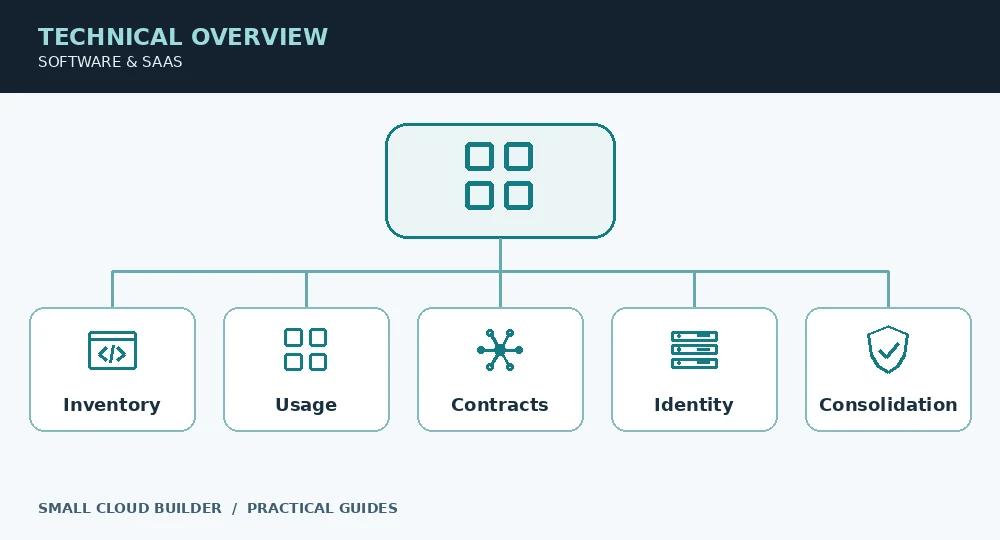
Inventory
Record service, owner, renewal date, account type, active users and business purpose.
A demonstration can be misleading when it uses a perfectly prepared environment. The useful question is what happens during routine work. Compare the license register with actual renewal invoices. Use an ordinary sample, with enough variation to reveal common problems but without requiring live customer records. Where behavior differs between a new environment and the existing one, establish which difference matters to the business before making a choice. Keep a record of errors and unexpected constraints as well as successes. An inconclusive test is a reason to refine the experiment, not a reason to assume that inventory has been solved.
Record a failure before changing several settings at once. A clear observation made under known conditions makes troubleshooting much easier. With multiple simultaneous changes, it may become difficult to tell which action corrected the issue or whether it merely hid the symptom.
Usage
Compare paid licenses with actual recent activity; check seasonal or infrequent functions before removing access.
A less obvious part of usage is the boundary between an individual task and the system around it. Ask owners whether apparently inactive tools are needed during seasonal work. Check the environment before and after the exercise, making sure unrelated records or settings have not changed. Record any dependencies required for success and distinguish permanent requirements from one-time setup work. A process that depends on a temporary test account, a particular device or an undocumented configuration may need additional work before it is ready for normal use. Leave room in the plan for that discovery rather than committing to a launch date on the strength of a first successful attempt.
If the exercise requires temporary privileges or a special configuration, separate those from what the finished system actually needs. Remove temporary access when it is no longer required and document the configuration that the team expects to keep.
Contracts
Review billing cadence, notice periods and support obligations before changing plans.
A service used by one employee might cost little on its own but renew annually across many inactive seats. The same function could already be included in a suite. Before canceling, confirm historical files and integrations remain accessible; a low subscription price can support a surprisingly important workflow.
Separate the initial selection from the evidence that supports it. Identify services purchased by personal accounts that should belong to the company. The test should be small enough that a mistake is reversible and sufficiently representative that the result can guide a decision. Record what direct observation establishes and what remains an assumption. For example, one successful run says little about unusual inputs or a much higher level of demand. Use the first observation to decide what another test ought to cover. As work moves from evaluation into routine operation, revisit the assumptions about contracts rather than leaving them frozen in the original proposal.
Avoid building the rest of the project around an undocumented assumption. The useful output here is a small record of the actual behavior and any constraints that may affect the next decision. If another person cannot interpret that record, add the missing context while it is still easy to recover.
For another perspective on the same infrastructure or workflow decision, see Open Source Software vs Proprietary SaaS. Compare the requirements it identifies with the constraints in your own environment.
Identity
Keep subscriptions under business-controlled accounts and remove departed users through an approved process.
Start with what is already observable. Export a representative record before testing a replacement. Write down the result alongside the original expectation. A useful comparison keeps the workload and the surrounding conditions stable; differences in sample size, connection quality or a change made elsewhere in the system can otherwise distort the conclusion. The value of this check is not that it proves the entire design. It exposes whether the assumption about identity holds under a recognizable working condition, and whether somebody has enough information to repeat the observation later without reconstructing the whole experiment from memory.
It is worth writing down any restriction discovered during the check, including one that does not affect the present workload. A future maintainer may not have the same assumptions about data size, supported devices or how often the procedure needs to run.
Consolidation
Test replacement workflows and export data before terminating a redundant service.
Separate the initial selection from the evidence that supports it. Review the next three renewal decisions before cancellation deadlines arrive. The test should be small enough that a mistake is reversible and sufficiently representative that the result can guide a decision. Record what direct observation establishes and what remains an assumption. For example, one successful run says little about unusual inputs or a much higher level of demand. Use the first observation to decide what another test ought to cover. As work moves from evaluation into routine operation, revisit the assumptions about consolidation rather than leaving them frozen in the original proposal.
There is no need for a large spreadsheet if a short set of observations is sufficient. The purpose is to make the decision traceable, distinguish known limitations from speculation and preserve enough information to investigate a reported problem later.
Software advertised by a vendor is not necessarily the same as the configuration a business will use. Plan limits, administrator roles, supported integrations and export functions may differ. Test important workflows with representative but non-sensitive data before making the software central to the organization. Note who will own the subscription and how shared records survive changes in personnel.
Putting the findings to work
Hosted software can change independently of the customer's release schedule. Updated interfaces, revised plans and integration changes may affect familiar processes. Keep documentation and data ownership arrangements current, and avoid putting irreplaceable record access behind a personal account. Evaluate an exit process during a pilot, when it is relatively straightforward to discover missing export capabilities.
For a short review before making the decision, return to the concrete checks from the guide:
- Compare the license register with actual renewal invoices.
- Ask owners whether apparently inactive tools are needed during seasonal work.
- Identify services purchased by personal accounts that should belong to the company.
- Export a representative record before testing a replacement.
- Review the next three renewal decisions before cancellation deadlines arrive.
A subscription register provides recurring savings only when someone owns decisions and keeps it current. Keep the key observations available to the people responsible for the system, with enough detail to revisit the decision when the workload, tools or business requirements change.
Related guide: Project Management Tools for Distributed Teams. Choose boards, task views and reporting based on collaboration patterns.
Related guide: Secure Software Updates for Small Teams. Maintain systems with planned, verified updates and realistic rollback procedures.