How to Evaluate SaaS for a Small Business
Assess software subscriptions using workflows, access controls and real ownership costs.
A consultancy is comparing new scheduling, project and customer-management software. Buy software after a pilot demonstrates a real workflow improvement and a feasible exit path. This is a useful situation in which to make the technical requirements explicit before changing tools, because the choices affect day-to-day work as well as the initial setup.
Software advertised by a vendor is not necessarily the same as the configuration a business will use. Plan limits, administrator roles, supported integrations and export functions may differ. Test important workflows with representative but non-sensitive data before making the software central to the organization. Note who will own the subscription and how shared records survive changes in personnel.
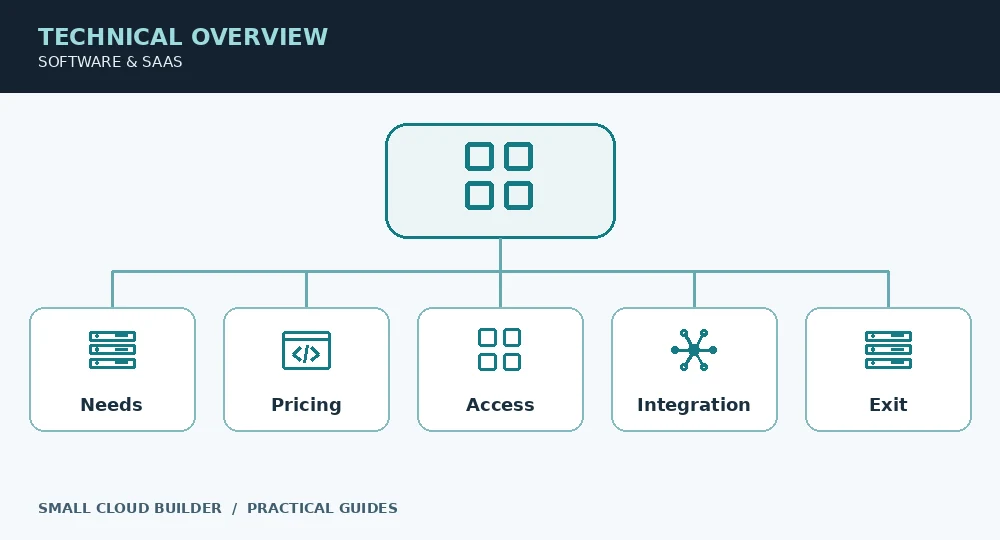
Needs
List the daily tasks each role must complete and distinguish requirements from optional conveniences.
There is a straightforward way to turn needs into a decision instead of an argument about features. Ask two roles to complete the same sample workflow in competing products. Keep the result in a short working note: the starting conditions, what was changed, what actually happened and the outcome that would be acceptable in production. If the result is different from the expected behavior, isolate the cause before adding another component. This is particularly important for a small team, where the person implementing a solution is often also the person who will have to maintain it and explain a failure to colleagues.
Avoid building the rest of the project around an undocumented assumption. The useful output here is a small record of the actual behavior and any constraints that may affect the next decision. If another person cannot interpret that record, add the missing context while it is still easy to recover.
Pricing
Count paid seats, usage limits, additional features, support and data export costs over a full year.
If a tool saves two staff members ten minutes per workday, the apparent gain is roughly 6.7 hours in a twenty-day month. Determine whether those minutes actually become useful time after importing, correcting and managing records. Subscription pricing alone does not establish a return on investment.
Separate the initial selection from the evidence that supports it. Count active users and paid upgrade requirements rather than theoretical capacity. The test should be small enough that a mistake is reversible and sufficiently representative that the result can guide a decision. Record what direct observation establishes and what remains an assumption. For example, one successful run says little about unusual inputs or a much higher level of demand. Use the first observation to decide what another test ought to cover. As work moves from evaluation into routine operation, revisit the assumptions about pricing rather than leaving them frozen in the original proposal.
The cost of an incorrect assumption increases as more people or records depend on it. Resolve uncertainty while the configuration is still small. A precise limitation is more useful than a general assurance that the system should probably work in a larger environment.
Access
Check role separation, identity integration, employee departure procedures and audit records.
The distinction becomes easier to see with an explicit acceptance test. Check whether removing a test user transfers ownership of shared records. Decide in advance which outcome would be a success. A measurement that looks impressive on its own may be irrelevant if the original task remains difficult or unreliable. Track failures alongside the successful result; a capability that works only when a particular person is present may be less useful than a slightly slower process anyone on the team can follow. The final choice should reflect the actual working requirements around access, including what the team can reasonably support after the initial installation.
Record a failure before changing several settings at once. A clear observation made under known conditions makes troubleshooting much easier. With multiple simultaneous changes, it may become difficult to tell which action corrected the issue or whether it merely hid the symptom.
For another perspective on the same infrastructure or workflow decision, see SaaS Subscription Management for Small Teams. Compare the requirements it identifies with the constraints in your own environment.
Integration
Test data imports, common integrations and API constraints using representative non-sensitive records.
A less obvious part of integration is the boundary between an individual task and the system around it. Import and export a representative set containing relationships and attachments. Check the environment before and after the exercise, making sure unrelated records or settings have not changed. Record any dependencies required for success and distinguish permanent requirements from one-time setup work. A process that depends on a temporary test account, a particular device or an undocumented configuration may need additional work before it is ready for normal use. Leave room in the plan for that discovery rather than committing to a launch date on the strength of a first successful attempt.
When comparing choices, include the ordinary maintenance procedure as a requirement. If the team can only demonstrate a capability with extensive assistance, plan for that dependency rather than assuming the same results will be available without it.
Exit
Review export formats, cancellation procedures and whether historical records remain usable elsewhere.
A demonstration can be misleading when it uses a perfectly prepared environment. The useful question is what happens during routine work. Estimate a full year of ordinary and high-use subscription costs. Use an ordinary sample, with enough variation to reveal common problems but without requiring live customer records. Where behavior differs between a new environment and the existing one, establish which difference matters to the business before making a choice. Keep a record of errors and unexpected constraints as well as successes. An inconclusive test is a reason to refine the experiment, not a reason to assume that exit has been solved.
There is no need for a large spreadsheet if a short set of observations is sufficient. The purpose is to make the decision traceable, distinguish known limitations from speculation and preserve enough information to investigate a reported problem later.
Putting the findings to work
The licensing bill is only one element of operational cost. People spend time mapping incoming records, maintaining templates, resolving synchronization issues and training colleagues. Those recurring tasks should be visible during evaluation. A modest subscription that eliminates a significant manual step can be better value than a feature-rich alternative that requires additional administration.
For a short review before making the decision, return to the concrete checks from the guide:
- Ask two roles to complete the same sample workflow in competing products.
- Count active users and paid upgrade requirements rather than theoretical capacity.
- Check whether removing a test user transfers ownership of shared records.
- Import and export a representative set containing relationships and attachments.
- Estimate a full year of ordinary and high-use subscription costs.
Buy software after a pilot demonstrates a real workflow improvement and a feasible exit path. Keep the key observations available to the people responsible for the system, with enough detail to revisit the decision when the workload, tools or business requirements change.
Related guide: Customer Relationship Management Software: Selection Guide. Choose a CRM around the sales and service processes actually used.
Related guide: Choosing a Domain Name for a Business Website. Evaluate readability, ownership, renewal and practical brand use.