How Domain Names and DNS Work
Follow a domain from registration and authoritative DNS to the browser.
A business keeps its domain registration separate from its website hosting and wants email uninterrupted during a move. Understanding who controls the registration and DNS zone prevents common migration and renewal mistakes. The details matter more than product labels. The challenge is to understand which parts of the system the business depends on, where the limits are and how to check the proposed approach under realistic conditions.
Public pages are accessed by people, browsers, search systems and links from other websites. Stable addresses matter because those consumers do not all update immediately when a new version is deployed. Keep internal links consistent, preserve appropriate destinations for changed addresses and verify real response codes. A page that looks correct in one browser does not demonstrate that the old and new public paths work correctly.
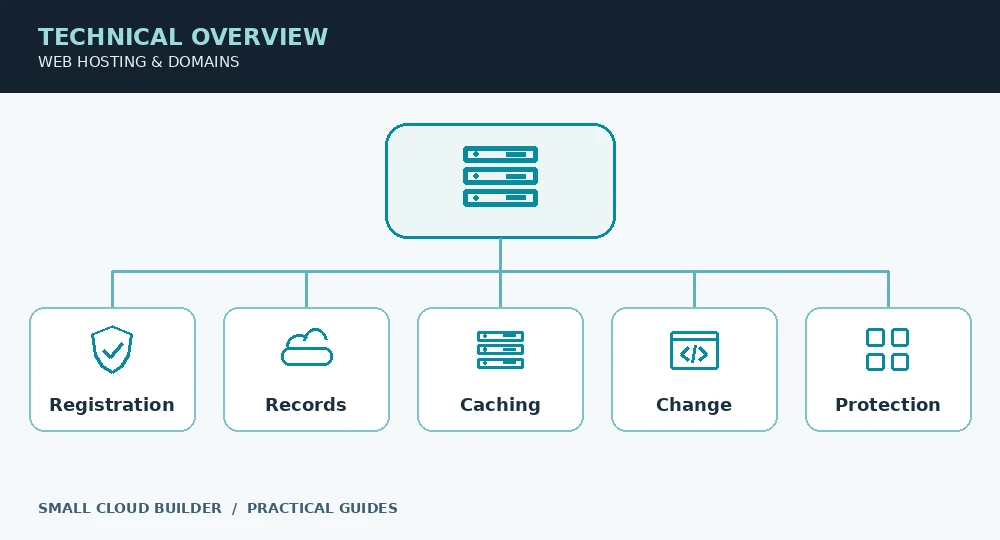
Registration
The registrar manages the domain registration; authoritative nameservers publish DNS records. They can be different companies.
A demonstration can be misleading when it uses a perfectly prepared environment. The useful question is what happens during routine work. Compare registrar records with authoritative DNS answers for the site and mail. Use an ordinary sample, with enough variation to reveal common problems but without requiring live customer records. Where behavior differs between a new environment and the existing one, establish which difference matters to the business before making a choice. Keep a record of errors and unexpected constraints as well as successes. An inconclusive test is a reason to refine the experiment, not a reason to assume that registration has been solved.
Before extending the setup, identify the part that is hardest to reverse. A limited pilot lets the team address problems in that part without affecting unrelated work. Keep the dependable existing process available until the replacement has passed the checks that matter.
Records
Use A and AAAA for IP addresses, CNAME for aliases when permitted, MX for email routing and TXT for verification and policies.
An implementation plan should state who owns records once the work is complete. Record the existing zone before touching nameservers. Ask the person responsible for ongoing administration to take part in verifying the result, rather than handing them an unfamiliar setup at the end. They need to know where to find the relevant configuration, what a normal result looks like and what to do if it changes unexpectedly. Where two roles share responsibility, document the handoff. In a small organization, clear ownership and a repeatable check often prevent problems that an additional piece of software would merely make more difficult to investigate.
Treat a successful result as evidence for the particular situation that was tested. Changes to the environment can alter that behavior. A lightweight regression check after important changes makes it easier to identify when a previously dependable assumption no longer holds.
Caching
TTL influences resolver caching but does not force all clients to switch at a precise instant.
Changing an A record affects a hostname's IPv4 destination; replacing nameservers changes which authoritative system provides the entire zone. That is a larger operation. If the new zone lacks MX or TXT records, mail problems can appear even when the website looks correct. Reviewing the full record inventory is essential.
A less obvious part of caching is the boundary between an individual task and the system around it. Verify expected IPv4 and IPv6 destinations in an appropriate test environment. Check the environment before and after the exercise, making sure unrelated records or settings have not changed. Record any dependencies required for success and distinguish permanent requirements from one-time setup work. A process that depends on a temporary test account, a particular device or an undocumented configuration may need additional work before it is ready for normal use. Leave room in the plan for that discovery rather than committing to a launch date on the strength of a first successful attempt.
Avoid building the rest of the project around an undocumented assumption. The useful output here is a small record of the actual behavior and any constraints that may affect the next decision. If another person cannot interpret that record, add the missing context while it is still easy to recover.
For another perspective on the same infrastructure or workflow decision, see Static Website Hosting Explained. Compare the requirements it identifies with the constraints in your own environment.
Change
Record current nameservers and records, lower TTL ahead of planned changes when practical, and verify both mail and website resolution.
The distinction becomes easier to see with an explicit acceptance test. Check for a forgotten subdomain before selecting a canonical host. Decide in advance which outcome would be a success. A measurement that looks impressive on its own may be irrelevant if the original task remains difficult or unreliable. Track failures alongside the successful result; a capability that works only when a particular person is present may be less useful than a slightly slower process anyone on the team can follow. The final choice should reflect the actual working requirements around change, including what the team can reasonably support after the initial installation.
It is worth writing down any restriction discovered during the check, including one that does not affect the present workload. A future maintainer may not have the same assumptions about data size, supported devices or how often the procedure needs to run.
Protection
Enable account MFA, protect renewal access and keep recovery contact information current.
Start with what is already observable. Observe DNS results from different resolvers during a planned low-risk change. Write down the result alongside the original expectation. A useful comparison keeps the workload and the surrounding conditions stable; differences in sample size, connection quality or a change made elsewhere in the system can otherwise distort the conclusion. The value of this check is not that it proves the entire design. It exposes whether the assumption about protection holds under a recognizable working condition, and whether somebody has enough information to repeat the observation later without reconstructing the whole experiment from memory.
The cost of an incorrect assumption increases as more people or records depend on it. Resolve uncertainty while the configuration is still small. A precise limitation is more useful than a general assurance that the system should probably work in a larger environment.
Putting the findings to work
Website files and application state are different. Static files can usually be deployed together and rolled back as one release, whereas a live database or order history may keep changing after a deployment. A rollback plan must take those differences into account. Do not assume restoring an older application version can also restore a newer database state safely.
For a short review before making the decision, return to the concrete checks from the guide:
- Compare registrar records with authoritative DNS answers for the site and mail.
- Record the existing zone before touching nameservers.
- Verify expected IPv4 and IPv6 destinations in an appropriate test environment.
- Check for a forgotten subdomain before selecting a canonical host.
- Observe DNS results from different resolvers during a planned low-risk change.
Understanding who controls the registration and DNS zone prevents common migration and renewal mistakes. Keep the key observations available to the people responsible for the system, with enough detail to revisit the decision when the workload, tools or business requirements change.
Related guide: HTTPS and TLS Certificates for Website Owners. Understand certificate trust, renewal and safe HTTPS transitions.
Related guide: Web Performance Basics for Developers. Reduce unnecessary requests, transfer size and main-thread work.